
India’s infrastructure, agriculture, construction, water supply, and sanitation sectors continue to create demand for PVC pipes. These pipes are widely used in plumbing, irrigation, drainage, electrical conduits, borewells, and industrial applications. This makes PVC pipe manufacturing a practical business opportunity for entrepreneurs planning to enter the plastic processing industry.
However, setting up a PVC pipe manufacturing unit requires more than purchasing machinery. A successful setup depends on matching your product plans with realistic costs, regulatory requirements, dependable material sourcing, and a production system designed for consistent output.
This guide explains the major steps involved in starting a PVC pipe manufacturing company in India.
Research the PVC Pipe Market Before Investing
Market research should be completed before selecting machinery or finalizing production capacity. Demand for PVC pipes varies according to construction activity, agricultural requirements, government projects, local competition, and distributor availability.
Study the market in the region where you intend to sell. Identify which pipe sizes and categories are regularly purchased and whether customers prefer economy, standard, or premium-quality products.
Your research should cover:
- Local demand for PVC pipes
- Frequently sold pipe sizes
- Construction and irrigation requirements
- Existing manufacturers and brands
- Dealer and distributor networks
- Market pricing
- Transportation costs
- Customer payment terms
This information will help you select a suitable product range and avoid investing in production capacity that the market may not support.
Select the Right PVC Pipe Category
PVC pipes are manufactured for different applications. Each category may require different die moulds, machine settings, raw material formulations, and testing standards.
Common product categories include:
- Agricultural irrigation pipes
- Plumbing pipes
- SWR pipes
- Electrical conduit pipes
- Borewell casing pipes
- Pressure pipes
- Drainage pipes
New manufacturers should generally begin with one or two categories that have consistent demand in their target market. A focused product range makes production planning, inventory management, quality control, and distribution easier.
Additional pipe categories can be introduced after the factory develops stable production and a reliable sales network.
Estimate the Required Investment
The cost of starting a PVC pipe manufacturing business depends on production capacity, pipe diameter range, factory size, machinery configuration, automation level, and working capital.
The cost of the extrusion line is only one part of the total investment. The complete budget should include factory infrastructure, die moulds, auxiliary machines, utilities, raw materials, manpower, packaging, and operating expenses.
Major investment areas include:
- Factory building or industrial shed
- PVC pipe extrusion line
- Pipe die heads and moulds
- Mixing and cooling equipment
- Electrical installation
- Water cooling system
- Auxiliary machinery
- Installation and commissioning
- Raw material inventory
- Labour expenses
- Packaging and transportation
- Working capital
A detailed project report can help estimate the total setup cost, monthly operating expenses, production targets, and expected cash requirements.
The lowest-priced option may not provide the reliability, output consistency, or technical support needed for long-term production. Machine durability, energy use, component quality, service support, spare-parts availability, and expected output should also be evaluated.
Complete Business Registrations and Approvals
The registrations required for a PVC pipe manufacturing unit may vary according to the business structure, factory size, location, and product category.
Common requirements may include:
- Business entity registration
- PAN and GST registration
- Udyam registration
- Factory licence, where applicable
- Trade licence
- Pollution Control Board consent
- Labour-related registrations
- Fire safety approval, where applicable
- BIS certification or relevant product compliance
Manufacturers should verify the latest requirements with the concerned government departments and qualified compliance professionals before beginning commercial production.
Source Suitable Raw Materials
Raw material quality directly influences pipe strength, surface finish, durability, processing stability, and rejection rates. Inconsistent raw materials can create production problems even when good machinery is being used.
PVC pipe production commonly involves:
- PVC resin
- Calcium carbonate
- Heat stabilizers
- Lubricants
- Processing aids
- Impact modifiers
- Pigments
- Application-specific additives
The formulation depends on the type of pipe, required quality, production speed, applicable standards, and end-use application.
Manufacturers should work with reliable suppliers and maintain batch records for raw materials. Material formulations should be developed under suitable technical guidance instead of using unverified recipes.
Choose Machinery According to Production Needs
Machinery selection should be based on the planned pipe category, diameter range, expected output, available electrical load, automation requirement, and factory space.
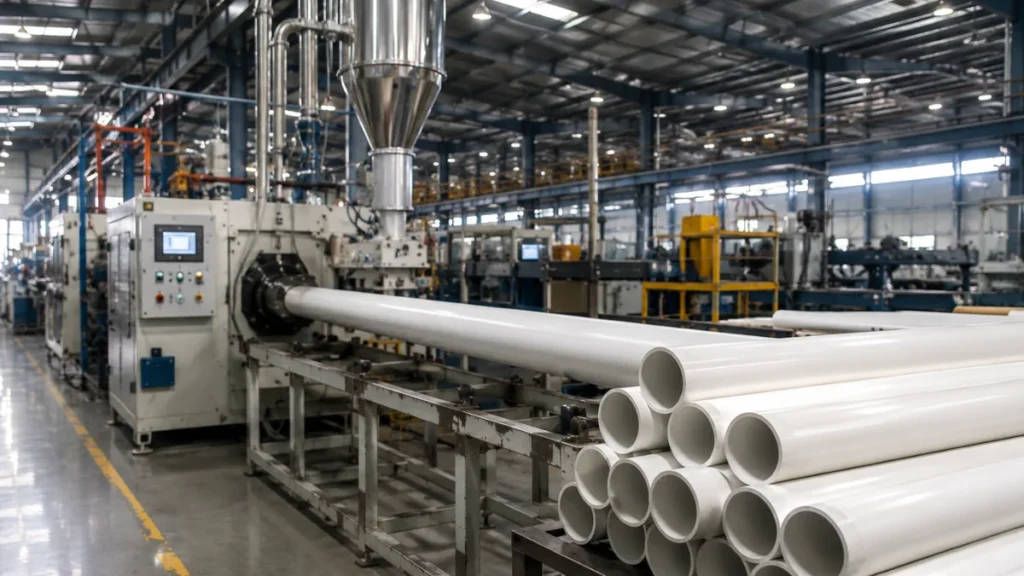
A PVC pipe production line may include:
- PVC pipe extrusion line
- High-speed mixer and cooler
- Pipe die head and die moulds
- Vacuum sizing tank
- Cooling tank
- Haul-off machine
- Printing unit
- Cutting machine
- Socketing or belling machine
- SWR pipe socketing machine
- Plastic pipe slotting machine
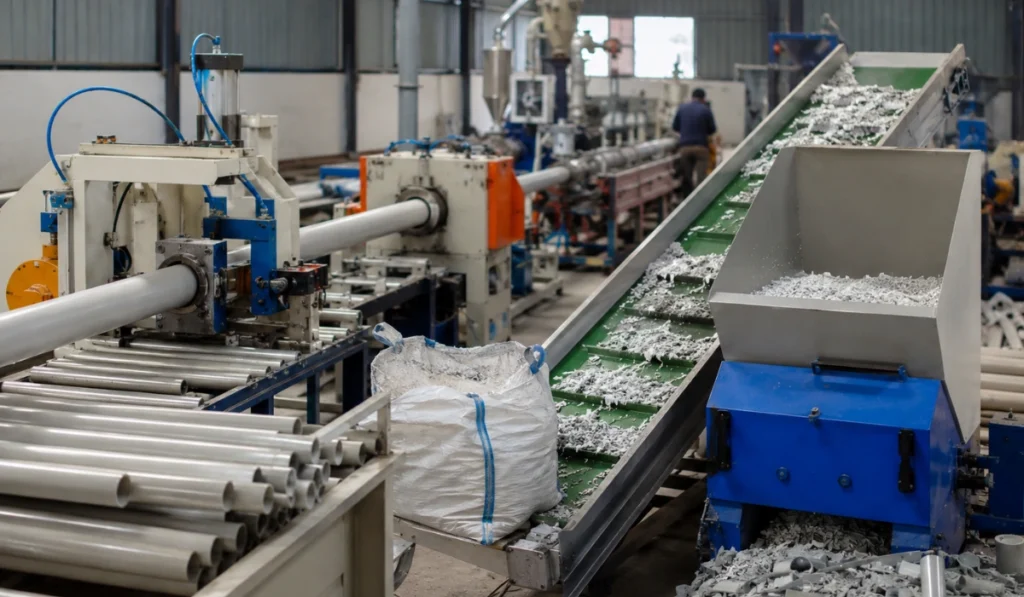
- PVC scrap grinder
- PVC pulverizer
- PVC disc pulverizer
- Air compressor
- Chiller or cooling system
- Material-handling equipment
- Quality-testing instruments
Not every factory requires all supporting machines at the beginning. Equipment should be selected according to the products being manufactured and the planned production workflow.
Dass Engineering Private Limited has been manufacturing machinery for PVC, CPVC, HDPE, and PET processing applications since 1975. The company provides CAD/CAM-engineered machinery, customization support, installation guidance, and after-sales assistance for new and existing manufacturing units.
PVC Pipe Manufacturing Process
PVC pipe production involves controlled mixing, extrusion, sizing, cooling, cutting, and finishing. Temperature, material consistency, extrusion pressure, cooling, and machine speed must be monitored to maintain pipe dimensions and quality.
The usual production process includes:
- PVC resin is mixed with additives according to the required formulation.
- The prepared compound is fed into the extrusion machine.
- The material is heated and plasticized inside the extruder.
- The molten compound passes through the die head and takes the shape of a pipe.
- The pipe enters the vacuum sizing tank to maintain the required dimensions.
- Water cooling stabilizes the shape and temperature.
- The haul-off unit pulls the pipe at a controlled speed.
- Product details are printed where required.
- The pipe is cut to the specified length.
- Socketing, belling, or slotting is completed according to the product.
- The finished pipes are inspected, packed, and stored.
Consistent machine settings and trained operators help reduce material wastage, dimensional variation, and product rejection.
Maintain Quality Control
Quality control should be part of every production stage rather than being limited to the final inspection. Regular testing helps identify process variations before they affect an entire production batch.
Manufacturers should monitor:
- Outer diameter
- Wall thickness
- Pipe weight
- Surface finish
- Straightness
- Socket dimensions
- Impact resistance
- Pressure performance, where applicable
- Raw material batches
- Production records
Applicable BIS standards and customer specifications should be followed according to the type of pipe being manufactured.
Improve Production Efficiency
Factory profitability depends on capacity utilization, material wastage, electricity consumption, labour productivity, maintenance expenses, and machine downtime.
Production efficiency can be improved by training operators, recording output, monitoring rejection rates, and following preventive maintenance schedules.
Useful practices include:
- Maintaining stable machine settings
- Scheduling regular servicing
- Keeping critical spare parts available
- Monitoring energy consumption
- Controlling raw material wastage
- Recording daily output and rejection
- Maintaining clean cooling and feeding systems
Higher machine output is useful only when the finished pipes meet the required quality standards and can be sold consistently.
Common Mistakes to Avoid
New manufacturers should avoid:
- Purchasing machinery before studying market demand
- Selecting equipment only because it is cheaper
- Starting with too many product categories
- Underestimating working capital
- Ignoring electrical and cooling requirements
- Using inconsistent raw materials
- Skipping quality testing
- Buying excessive production capacity
- Ignoring spare-parts availability
- Choosing a supplier without after-sales support
- Starting production without required approvals
Preventing these mistakes can reduce avoidable expenses and production delays.
How to Choose a PVC Pipe Machinery Manufacturer
Machinery is a long-term investment, so the manufacturer should be evaluated on technical capability, machine quality, service support, and industry experience.
Before placing an order, consider:
- Manufacturing experience
- Machine construction and components
- Suitable production capacity
- Customization options
- Installation support
- Operator guidance
- Spare-parts availability
- Warranty terms
- Maintenance support
- Existing customer feedback
Dass Engineering Private Limited manufactures machinery for PVC, CPVC, HDPE, and PET processing applications. With manufacturing experience since 1975, the company supports customers with customized machinery, CAD/CAM production, technical guidance, and dependable after-sales assistance.
Conclusion
Starting a PVC pipe manufacturing company in India requires proper market research, realistic budgeting, suitable raw materials, regulatory compliance, reliable machinery, and consistent quality control.
The right production setup should match your target pipe range, expected output, available utilities, market demand, and future expansion plans. Avoid selecting machinery based only on price or maximum capacity. Long-term machine reliability, output quality, energy use, maintenance requirements, and service support are equally important.
Businesses planning to establish or expand a PVC pipe manufacturing unit can consult Dass Engineering Private Limited, a Top PVC Pipe Machinery Manufacturer in India, to discuss pipe sizes, production capacity, automation requirements, factory location, electrical load, and budget before selecting a suitable machinery configuration.
Read More: Is PVC Pipe Manufacturing Profitable?
Frequently Asked Questions
How much investment is required to start a PVC pipe manufacturing company?
The investment depends on factory infrastructure, production capacity, pipe sizes, machinery configuration, automation level, raw material inventory, and working capital. A project-specific estimate is more useful than a fixed general figure.
Which machinery is required for PVC pipe manufacturing?
A typical setup includes an extrusion line, mixer and cooler, die moulds, vacuum sizing tank, cooling tank, haul-off machine, cutting unit, and relevant auxiliary machinery. Socketing machines, grinders, pulverizers, and slotting machines may also be required depending on the product range.
Is PVC pipe manufacturing profitable?
Profitability depends on market demand, capacity utilization, raw material prices, electricity costs, product quality, wastage control, dealer margins, and payment cycles. Efficient production and a reliable sales network are essential.
Which registrations are required?
Common requirements may include business registration, GST, Udyam registration, factory-related approvals, Pollution Control Board consent, and relevant product certifications. Requirements should be confirmed according to the state and product category.
How should a PVC pipe machinery manufacturer be selected?
Compare industry experience, machine quality, output capacity, customization, component reliability, spare-parts availability, installation support, warranty, and after-sales service rather than considering price alone.