
PVC resin prices have been unusually volatile in India during 2026, making raw-material purchasing, pipe pricing, inventory management, and working-capital planning more difficult for manufacturers.
The year has already shown how quickly conditions can change. Industry research cited by ETManufacturing indicates that domestic PVC resin prices rose to around ₹117/kg in March 2026 during disruption linked to the West Asia crisis, before falling by roughly 30% to around ₹83/kg in early July as supply conditions improved. More recently, industry checks reported domestic PVC resin at around ₹94/kg from September 1, 2026, indicating that prices had started firming again.
For PVC pipe manufacturers, however, the important question is not simply, “What is PVC resin costing today?”
It is:
Why are prices moving, what could move them next, and how should a pipe factory manage production and purchasing when resin costs are volatile?
This guide explains the 2026 PVC resin price trend in India, the factors behind it, the impact on PVC pipe manufacturers, and the practical decisions factories should consider.
What Is the PVC Resin Price Trend in India in 2026?
The simplest description of the 2026 market is volatile rather than consistently rising or falling.
According to sector research, domestic PVC resin prices climbed sharply during March as geopolitical disruption pushed up crude-linked costs and affected market expectations. Prices subsequently corrected as supply normalized and lower-priced material became more available. ETManufacturing, citing JM Financial, reported a movement from around ₹117/kg in March to about ₹83/kg by early July.
PL Capital provides another useful reference point: it reported domestic PVC resin at approximately ₹115/kg on April 1, falling to ₹80/kg by July 1, before recovering to ₹94/kg from September 1.
So the broad 2026 pattern has been:
Sharp rise → significant correction → stabilization → renewed firmness
That matters because a pipe manufacturer’s raw-material strategy should not be built around the assumption that today’s resin price will remain unchanged for the next production cycle.
Read this: Is PVC Pipe Manufacturing Profitable?
What Is the Current PVC Resin Price in India?
There is no single nationwide PVC resin price that applies to every buyer every day.
Prices can vary according to resin grade, domestic or imported origin, supplier, location, quantity, freight, taxes, payment terms, and whether the buyer is looking at a producer list price, distributor offer, import-parity price, or spot-market transaction.
For context, industry checks reported domestic PVC resin at around ₹94/kg at the beginning of September 2026, following an increase of ₹2/kg from September 1.
This should be treated as a market reference, not a permanent quotation.
A manufacturer making a purchasing decision should obtain current offers from suppliers or authorized distributors for the required grade and delivery location.
Which PVC Resin Is Commonly Used for Pipe Manufacturing?
PVC is available in different grades, and the correct resin depends on the processing application.
For rigid PVC pipe extrusion, suspension PVC (S-PVC) is particularly important. K-value is one of the specifications commonly used to differentiate suspension grades. Current Indian market reporting identifies K67 as a widely referenced grade for pipes and profiles, although manufacturers should always purchase resin according to their actual formulation and product requirements rather than choosing a grade merely because it is common in the market.
This distinction is important when discussing “PVC resin prices.” A quote for one grade or type of PVC should not automatically be assumed to represent every PVC material.
Why Did PVC Resin Prices Rise Sharply in 2026?
There is no single cause.
PVC resin prices in India are influenced by a combination of global feedstock costs, crude oil and energy markets, imports, exchange rates, domestic supply, demand, freight, inventories, and government trade policy.
1. Crude oil and upstream costs
PVC has a complex upstream supply chain involving raw materials such as ethylene dichloride (EDC) and vinyl chloride monomer (VCM). Changes in energy and feedstock markets can therefore influence resin production economics.
Crisil Ratings said in June that higher crude prices following the West Asia conflict and a depreciating rupee were expected to keep resin prices elevated.
2. India’s dependence on imported PVC resin
Imports have a major influence on Indian pricing.
Crisil estimates that around two-thirds of the resin requirements of PVC pipe manufacturers are imported. It also estimates that resin accounts for approximately 75–80% of their total costs.
That combination makes pipe manufacturers particularly sensitive to international PVC prices, freight, exchange rates, and import policy.
3. Rupee-dollar movement
Imported resin is generally exposed to foreign-currency pricing.
If the rupee weakens against the US dollar, the landed rupee cost of imported material can rise even if the international dollar price of PVC itself remains relatively stable.
The exchange rate, therefore, deserves attention alongside international resin quotations.
Also Read: How to Start a PVC Manufacturing Company in India
4. Domestic demand
PVC demand is connected with sectors such as irrigation, water supply, housing, construction, and infrastructure.
Crisil estimates irrigation accounts for roughly 45% of PVC pipe demand, while plumbing and water-supply applications linked with urban infrastructure and real estate account for the remaining 55%.
Seasonality, monsoons, agricultural activity, government projects, housing construction, and infrastructure spending can therefore influence resin buying.
5. Inventory behaviour
When manufacturers and distributors expect prices to rise, they may increase purchases. When they expect prices to fall, they may reduce inventories and buy only immediate requirements.
That behaviour can amplify short-term market movements.
For pipe manufacturers, resin prices therefore need to be viewed together with inventory levels and downstream demand, not in isolation.
What Changed With PVC Resin Imports in 2026?
This is one of the most important developments for Indian manufacturers this year.
The Government of India introduced a six-month minimum import price (MIP) of US$0.766/kg for suspension-grade PVC resin, with imports below the threshold restricted subject to the notification’s terms and exemptions. The Commerce Ministry said the measure is intended to reduce import dependence over time, while clarifying that it is not an outright import ban or quota.
The underlying demand-supply situation is important.
According to figures cited by the Commerce Ministry, Indian domestic S-PVC capacity is approximately 1,615 KT per year, compared with demand of approximately 4,139 KT per year.
That gap helps explain why imports remain important to Indian processors.
For PVC pipe manufacturers, the practical implication is that international prices and Indian trade policy can have a direct influence on domestic raw-material economics.
You May Like: How Socketing, Slotting, and Scrap Processing Complete a PVC Pipe Production Line
Are PVC Resin Prices Increasing Again?
As of early September 2026, available market evidence points toward renewed firmness after the sharp mid-year correction.
PL Capital reported domestic prices rising to around ₹94/kg from September 1. Market reporting in early September also described PVC prices across Indian extrusion hubs as firming, citing higher upstream feedstock costs and tighter import availability among the supporting factors.
However, manufacturers should be careful with statements such as “PVC prices will continue increasing.”
Commodity markets can reverse quickly.
The better conclusion is:
PVC resin prices had begun recovering by early September after falling sharply during the middle of 2026, but the direction ahead remains dependent on global feedstocks, imports, currency movements, domestic demand, and policy conditions.
Will PVC Resin Prices Increase Further in 2026?
No one can reliably guarantee the direction of PVC resin prices.
Crisil said in June that resin prices could moderate as geopolitical conditions eased, while still averaging above pre-conflict levels. It identified global resin-price volatility, developments in West Asia, and recovery in end-user demand as factors worth monitoring.
For the remainder of 2026, pipe manufacturers should watch:
- International PVC prices
- Crude oil and energy markets
- EDC and VCM feedstock trends
- USD/INR movement
- Import offers and landed costs
- Freight rates
- Domestic producer price revisions
- Government import policy
- Distributor inventories
- Irrigation and construction demand
Rather than attempting to predict one exact future price, manufacturers can prepare purchasing plans for rising, stable, and falling price scenarios.
Why Do PVC Resin Prices Matter So Much to Pipe Manufacturers?
Because resin represents a major share of pipe-manufacturing economics.
Crisil estimates that resin accounts for around 75–80% of total costs for PVC pipe makers.
Consider a simplified example.
If a factory processes 100 tonnes of material during a period, a ₹5/kg change in the relevant resin purchase cost can represent a substantial difference in gross raw-material expenditure before considering formulation, inventory timing, freight, taxes, or other inputs.
This is why apparently small per-kilogram changes can materially affect:
- Production cost
- Product pricing
- Gross margin
- Working capital
- Inventory value
- Dealer quotations
- Credit requirements
Raw-material purchasing, therefore, deserves management attention rather than being treated as a routine procurement activity.
How Do Higher Resin Prices Affect PVC Pipe Prices?
When resin costs rise significantly, pipe manufacturers generally face pressure to increase finished-product realizations or absorb part of the increase through margins and operational efficiency.
Crisil expects organised PVC pipe and fitting makers to see 12–15% higher realisations year-on-year during the current fiscal, with much of the higher resin cost expected to be passed on to customers.
But passing through a cost increase is not always immediate.
A manufacturer may have existing dealer commitments, project quotations, competitive pressure, older inventory purchased at another cost, or customers unwilling to accept an immediate revision.
That creates a timing problem between raw-material cost and finished-pipe pricing.
Also Read: Why PVC Pipe Factories Are Focusing More on Scrap Recovery and Recycling
How Do Resin Prices Affect Working Capital?
This is one of the most important effects for manufacturers.
When the price per tonne of resin rises, the same physical inventory requires more money.
For example, holding 50 tonnes of resin at ₹80/kg represents a different cash commitment from holding the same 50 tonnes at ₹100/kg.
Crisil expects higher resin prices to increase working-capital requirements for PVC pipe manufacturers. It reported manufacturer inventory at around 75 days as of March 31, 2026, and expects inventory holding to rise to approximately 85 days during the fiscal.
Smaller manufacturers should pay particular attention to this issue because excessive inventory can consume cash needed for electricity, wages, additives, transport, maintenance, and customer credit.
Should Pipe Manufacturers Buy More Resin When Prices Are Low?
Not automatically.
Buying additional inventory at a lower price can be beneficial if the material will actually be consumed within a reasonable production period and the factory has sufficient working capital.
But buying purely because the market has fallen can create a different risk.
If prices continue falling, the manufacturer may hold expensive inventory while competitors purchase cheaper material and reduce their finished-pipe prices.
This is commonly called inventory risk.
Before increasing resin inventory, consider:
- Confirmed orders
- Expected production
- Current stock
- Supplier lead time
- Price direction
- Cash availability
- Customer credit periods
- Storage capacity
- Risk of further price correction
The objective is not to buy at the absolute bottom—a price nobody can consistently predict. It is to maintain appropriate inventory for production without making the factory unnecessarily dependent on commodity speculation.
What Happens When Resin Prices Fall?
Falling resin prices are not automatically positive for every pipe manufacturer.
Yes, future raw-material purchases become cheaper. But a factory may already be holding inventory purchased at higher prices.
If competitors begin buying cheaper resin and reduce pipe prices, a manufacturer holding high-cost inventory can face margin pressure.
This is why a rapidly falling PVC market can sometimes be difficult for processors, even though raw-material prices are moving downward.
A stable market can be easier to manage than an extremely volatile one.
How Can PVC Pipe Manufacturers Control Costs During Resin Price Volatility?
Factories cannot control global PVC prices, but they can control how efficiently purchased material is converted into saleable pipe.
Reduce avoidable rejection
Track why pipes are rejected. Repeated dimensional problems, unstable processing, poor tooling, inappropriate machine settings, or handling damage should be corrected rather than accepted as routine scrap.
Improve start-up and changeover control
Frequent product changes can increase start-up waste. Better production scheduling and standardized operating procedures can help reduce unnecessary material loss.
Monitor material consumption
Compare actual material consumption against saleable output rather than simply recording extrusion output.
A useful internal indicator is:
Material yield = Saleable finished output ÷ Total material consumed × 100
The purpose is not to chase an arbitrary universal percentage, but to identify deterioration in your own process.
Keep scrap streams controlled
Clean, identified in-house scrap should be kept separate from contaminated or incompatible waste.
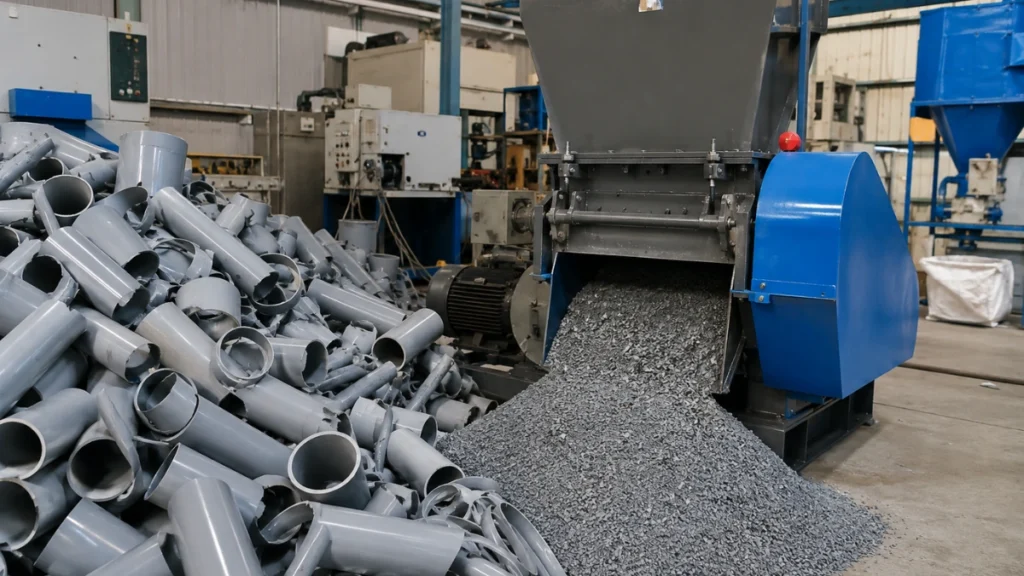
Where suitable, bulky production scrap may undergo size reduction using a scrap grinder. If finer processing is genuinely required, appropriately prepared material may be processed through a suitable pulverizer.
However, processing scrap does not automatically make it appropriate for reuse in every PVC pipe. Reuse depends on formulation, material condition, processing history, product requirements, quality controls, and applicable standards.
Maintain machinery properly
Poorly maintained equipment can contribute to unstable output, downtime, dimensional variation, and unnecessary waste.
Preventive maintenance should therefore be viewed partly as material-cost control, not merely as machine servicing.
Should Manufacturers Use Cheaper Raw Materials When PVC Prices Rise?
Price should never be the only criterion for raw-material selection.
A cheaper resin or additive combination that creates unstable processing, excessive rejection, inconsistent dimensions, or non-compliant finished pipes can ultimately cost more.
Factories should evaluate cost per kilogram of saleable compliant pipe, not simply the purchase price per kilogram of resin.
This distinction becomes particularly important during periods of high resin prices, when the temptation to reduce input costs is strongest.
Can Recycled PVC Reduce Dependence on Virgin Resin?
Suitable recovered material may have a role in some PVC manufacturing applications, but it should not be treated as a universal substitute for virgin resin.
Whether recovered PVC can be used—and in what proportion—depends on its source, formulation, contamination, processing history, required properties, intended application, quality-control results, and applicable product standards.
Therefore, manufacturers should not respond to higher resin prices by automatically increasing recycled content without technical and quality evaluation.
The better strategy is first to reduce avoidable material loss, then evaluate suitable recovery opportunities within the requirements of the product being manufactured.
What Should a Small PVC Pipe Manufacturer Monitor Every Week?
A small factory does not need an elaborate commodity-trading department.
A practical weekly review can include:
- Current supplier resin offers
- Domestic producer revisions
- Import price direction
- USD/INR movement
- Resin inventory in tonnes
- Average inventory cost
- Confirmed pipe orders
- Finished-goods inventory
- Current selling price
- Production and rejection
- Customer receivables
- Cash required for the next purchasing cycle
This gives management a much clearer picture than checking the daily PVC resin price alone.
How Should Manufacturers Quote Pipe Prices When Resin Is Volatile?
Long-validity quotations can become risky when the major raw material is moving quickly.
Manufacturers should clearly define quotation validity, applicable taxes, freight, quantity, payment terms, and other commercial conditions.
For longer-duration supply contracts or projects, businesses may need a pricing mechanism that appropriately addresses significant raw-material movements, subject to negotiation and contract terms.
The goal is not to transfer every minor market movement to the customer. It is to avoid committing to prices that become commercially unsustainable if the main input cost changes materially before supply.
What Does the 2026 Outlook Mean for PVC Pipe Manufacturers?
The industry picture is mixed rather than simply positive or negative.
Crisil expects organised PVC pipe and fitting manufacturers to achieve 10–15% revenue growth this fiscal because of higher realizations, even as overall sales volume is projected to decline by 3–5%. It also expects irrigation demand to grow by a modest 2–4%, while elevated costs could constrain plumbing and water-supply demand associated with urban infrastructure and real estate.
For manufacturers, this means revenue growth should not automatically be interpreted as stronger physical demand.
Higher selling prices can increase revenue even when fewer tonnes of pipe are sold.
That distinction matters when making decisions about capacity expansion, inventory, and machinery investment.
What Should PVC Pipe Manufacturers Do in a Volatile Resin Market?
The most practical response is not to try to predict every price movement.
Instead:
- Track landed resin cost, not just headline market prices.
- Know the average cost of existing inventory.
- Align purchasing with realistic production and confirmed demand.
- Avoid excessive speculative inventory.
- Track scrap and rejection by cause.
- Calculate the cost per kilogram of saleable pipe.
- Maintain machinery to reduce avoidable material losses.
- Review pipe pricing when raw material costs move materially.
- Protect working capital and monitor customer credit.
- Plan capacity according to demand rather than temporary price movements.
This approach cannot remove PVC price volatility, but it can reduce the factory’s exposure to it.
Where Machinery Efficiency Fits Into Resin Cost Control
A machine cannot control the market price of PVC resin.
It can, however, influence how effectively purchased material moves through production.
Stable processing, suitable tooling, appropriate downstream capacity, preventive maintenance, organized scrap handling, and correctly selected material-processing equipment can help manufacturers reduce avoidable losses.
For example, pipe factories may use socketing and slotting equipment for required downstream operations, while suitable production scrap may be processed through grinders or pulverizers according to the factory’s recovery requirements.
Dass Engineering Private Limited, with manufacturing roots dating to 1975, produces PVC pipe downstream and material-processing equipment, including pipe socketing/belling machines, slotting machines, PVC/CPVC/HDPE scrap grinders, pulverizers, and plastic pipe die moulds. For manufacturers evaluating a Top PVC pipe machinery manufacturer in India, the useful question during a high-cost raw-material environment is not merely the machine price—it is whether the equipment suits the actual material, pipe size, production capacity, power availability, and operating requirements.
Final Thoughts
The PVC resin price trend in India in 2026 has demonstrated why pipe manufacturers should treat raw-material management as a core part of factory management.
Prices rose sharply earlier in the year, corrected significantly by July, and had begun firming again by early September. At the same time, India’s dependence on imported S-PVC, currency movements, global feedstock costs, geopolitical developments, domestic demand, and changes in import policy continue to influence the market.
No manufacturer can reliably predict the exact resin price months in advance.
What a factory can control is how much material it holds, how efficiently that material is converted into saleable pipe, how quickly unnecessary rejection is identified, how purchasing is aligned with demand, and how working capital is protected.
In a volatile PVC market, the goal should therefore not be to guess the lowest possible buying price.
It should be to build a production and purchasing system that can remain financially workable whether resin prices move up, down, or sideways.
Frequently Asked Questions
What is the PVC resin price in India in 2026?
PVC resin prices have varied substantially during 2026. Industry reports indicate domestic prices reached roughly ₹115–117/kg around March-April, fell to approximately ₹80–83/kg by early July, and recovered to around ₹94/kg at the beginning of September. Actual prices vary by date, grade, supplier, location, quantity, freight, and commercial terms.
Why did PVC resin prices increase in India in 2026?
Important factors have included higher crude and upstream costs, geopolitical disruption, rupee depreciation, import dependence, supply conditions, inventory movements, and changes in India’s S-PVC import policy.
Will PVC resin prices rise further in 2026?
There is no reliable way to guarantee the direction. Manufacturers should monitor global PVC and feedstock prices, USD/INR, imports, freight, government policy, domestic inventories, and demand rather than relying on a single forecast.
Why does PVC resin price matter so much for pipe manufacturing?
Crisil estimates resin represents around 75–80% of PVC pipe makers’ total costs, making even relatively small changes in resin prices important for production cost, inventory value, working capital, and finished-pipe pricing.
Should PVC pipe manufacturers stock resin when prices fall?
Only when inventory levels are supported by realistic production requirements, demand, storage, and working capital. Buying excessive material simply because prices have fallen can expose the manufacturer to inventory losses if the market falls further.