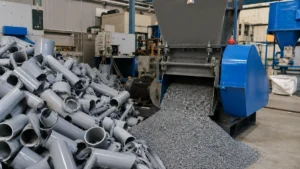

PVC pipe manufacturing inevitably generates some production scrap. Start-up material, pipe-end cuttings, rejected pipes, trial pieces, and waste produced during product or size changes can accumulate even when a production line is operating efficiently.
For a factory owner, this raises an important question: Should this material be discarded, or can suitable PVC scrap be recovered and used more efficiently?
PVC is a thermoplastic, which means suitable PVC waste can be mechanically processed for recycling. However, effective PVC scrap recovery and recycling involve much more than putting rejected pipes into a grinder. The source of the scrap, formulation, cleanliness, contamination, processing history, required particle size, intended reuse, product specifications, and applicable standards all need to be considered.
For this reason, a good PVC pipe factory should treat scrap recovery as part of material management and production control, not simply as a way to dispose of waste.
What Is PVC Scrap Recovery in a Pipe Factory?
PVC scrap recovery is the process of collecting, segregating, processing, and evaluating suitable PVC production waste so that it can be reused where appropriate or handled more efficiently.
Depending on the factory and material, this process may involve collecting scrap separately, checking it for contamination, reducing its size with a grinder, processing it further with a pulverizer when finer material is required, and evaluating the processed material before reuse.
A simple factory-level process can be understood as:
Collection → Segregation → Inspection → Size Reduction → Further Processing if Required → Storage → Quality Evaluation → Appropriate Reuse or Disposal
Not every factory needs every stage.
More importantly, recoverable scrap and reusable material are not automatically the same thing. A rejected PVC pipe may be physically suitable for grinding, but that does not mean the processed material should automatically be used in every new pipe.
Also Read: How to Start a PVC Manufacturing Company in India
Where Does Scrap Come From During PVC Pipe Manufacturing?
Some production scrap is normal. The quantity, however, can vary considerably depending on machine setup, product changes, process stability, operator practices, tooling, and quality requirements.
Common sources include:
- Start-up material generated while extrusion conditions stabilize
- Pipe ends and offcuts produced during cutting
- Pipes rejected during dimensional or visual inspection
- Material generated during machine trials
- Scrap produced during die or size changes
- Pipes damaged during production or handling
- Other clean in-house production waste
Before investing in a PVC scrap recycling machine, manufacturers should understand why the scrap is being generated.
For example, if excessive scrap is being caused by unstable extrusion conditions, incorrect machine settings, tooling problems, or frequent quality rejections, increasing recycling capacity does not solve the underlying production problem.
The better approach is to reduce avoidable scrap first, then recover suitable unavoidable scrap.
Why Are PVC Pipe Factories Paying More Attention to Scrap Recovery?
The main reasons are better material utilization, more organized waste handling, improved control over production losses, and increased attention to circular manufacturing.
For a factory, however, recycling should not be pursued simply because it is an industry trend. It needs to make sense technically and economically for the actual production process.
You May Like: Is PVC Pipe Manufacturing Profitable?
1. Production Scrap Still Has Material Value
Clean and properly identified in-house PVC scrap may have recovery potential for suitable applications.
Instead of treating every offcut or rejected pipe as a complete material loss, a factory can determine whether appropriate scrap can be processed and used again under controlled conditions.
The objective should not be to use the maximum possible recycled material. It should be to recover suitable material without compromising the required finished-product quality.
2. Bulky Scrap Requires Storage Space
Rejected pipes, long offcuts, and irregular PVC pieces can quickly occupy valuable factory space.
Reducing suitable scrap into smaller pieces can make it easier to collect, move, store, and prepare for subsequent processing.
This becomes particularly important as production volume increases because an unplanned scrap area can interfere with material movement and housekeeping.
3. Scrap Recovery Makes Material Loss Easier to Measure
Once a factory establishes a defined scrap-handling process, management can start asking useful questions:
How much scrap is generated per shift? Where is it coming from? How much is clean and recoverable? How much does processing cost? How much processed material can actually be reused?
These answers can help a manufacturer identify whether the priority should be better production control, improved segregation, additional scrap-processing capacity, or a combination of these measures.
Read This: How Socketing, Slotting, and Scrap Processing Complete a PVC Pipe Production Line
How Does PVC Pipe Scrap Recycling Work?
For suitable in-house production scrap, the recovery process generally begins with collection and segregation, not grinding.
Scrap should first be separated from contaminants and incompatible materials. The factory should know, as far as practical, where the material came from and whether its formulation is appropriate for the intended recovery route.
Larger PVC pipe scrap can then be reduced to a more manageable size. If the intended process requires finer material, suitable pre-sized material may undergo an additional pulverizing stage.
The processed material should then be stored in a controlled manner and evaluated according to the factory’s formulation, quality requirements, intended application, and applicable standards before any reuse decision is made.
This means a PVC recycling setup should be designed around the material that comes in and the material required at the end, rather than simply purchasing every available recycling machine.
PVC Scrap Grinder vs PVC Pulverizer: What Is the Difference?
A PVC scrap grinder reduces larger PVC waste into smaller, manageable pieces, while a PVC pulverizer is used for finer size reduction of suitable pre-sized material. Although both machines are involved in material processing, they perform different functions.
A PVC scrap grinder is generally used at the initial size-reduction stage. Pipe offcuts, rejected pipes, and other suitable bulky PVC scrap are fed into the grinder and reduced into smaller pieces. This makes the material easier to handle, store, or prepare for further processing.
A PVC pulverizer, on the other hand, is used when the production process requires a much finer material. Instead of handling large pipe sections directly, it typically processes suitable material that has already been reduced to a manageable size.
In practical terms, large PVC scrap is first reduced into smaller, manageable pieces using a scrap grinder. When finer material is required, the appropriately sized material can then be processed through a suitable pulverizer for further size reduction.
However, this does not mean every PVC pipe factory needs both machines. A factory that only requires coarse regrind may need a grinder, while another production setup may require both grinding and pulverizing. The right choice depends on the scrap type, input size, required output, processing capacity, and intended use of the recovered material.
Therefore, a grinder and a pulverizer should not be treated as interchangeable machines or purchased as a standard pair. Each should be selected according to the factory’s actual scrap-processing requirements.
Why Is Scrap Segregation Important Before Grinding?
A grinder can reduce the size of scrap, but it cannot correct poor material segregation.
Suppose clean PVC offcuts are mixed with metal pieces, dirt, packaging waste, rubber, another polymer, or PVC material of an unsuitable formulation. Grinding everything together simply produces smaller contaminated material.
That can make subsequent processing and quality control much more difficult.
Factories should therefore prevent clean production scrap from becoming contaminated in the first place. Depending on the production setup, material may need to be separated according to polymer, formulation, colour, product type, or production source.
Clean in-house production scrap can be easier to control than unknown external waste because the manufacturer has better information about its formulation and processing history.
The basic principle is simple: good recycling starts with good segregation.
Can Recycled PVC Scrap Be Used to Manufacture New Pipes?
Suitable recycled PVC may be used in appropriate applications, but processed scrap should not automatically be returned to every PVC pipe product.
Its suitability can depend on:
- Original PVC formulation
- Source and cleanliness of the scrap
- Presence of contamination
- Previous heat and processing history
- Required mechanical and physical properties
- Pipe application
- Quality-control results
- Applicable product standards
- Requirements governing recycled material use
This distinction matters because grinding or pulverizing changes the physical size of the material; it does not automatically restore the material to the same condition as virgin resin or compound.
A factory should therefore establish acceptable reuse criteria through its formulation controls, testing procedures, product requirements, and applicable standards.
Can a Factory Use 100% Recycled PVC for New Pipes?
There is no single recycled-content percentage that is appropriate for every PVC pipe and every application.
Different products can have different performance requirements. Pressure pipes, drainage products, casing pipes, profiles, fittings, and other PVC products should not automatically be treated as though their material requirements are identical.
The quality of recovered material can also vary according to its source, formulation, contamination, and previous processing.
Therefore, the amount of recycled material used should be determined by the specific application, formulation, required properties, quality testing, and applicable standards.
For manufacturers, the objective should be controlled and appropriate reuse, rather than maximizing recycled content simply to reduce virgin-material consumption.
Does PVC Scrap Recycling Reduce Manufacturing Costs?
Scrap recovery can improve material utilization, but it does not automatically guarantee lower production costs.
Processing scrap requires resources of its own. A factory may need labour for segregation and feeding, electricity for grinding or pulverizing, maintenance for the machinery, storage space for processed material, and quality checks before reuse.
A realistic calculation should consider:
Total recovery cost = collection + segregation + labour + electricity + processing + maintenance + storage + quality control
The factory can then compare this cost with the value of the usable material recovered and any improvement in waste handling.
Simply multiplying the weight of scrap by the purchase price of virgin material can give a misleading estimate of savings. Not every kilogram of scrap may be reusable, and recovered material may not replace virgin material on a one-to-one basis.
A more useful question is:
“How much usable material are we recovering after accounting for processing costs and quality requirements?”
That gives factory management a better basis for deciding whether additional recycling investment makes economic sense.
How Much Scrap-Processing Capacity Does a Factory Need?
Grinder or pulverizer capacity should be based primarily on the amount of material that actually needs processing, not simply on total pipe-production capacity.
Imagine an extrusion line producing a large quantity of finished pipe per shift. Only a fraction of that output may become recoverable scrap. A recycling machine does not necessarily need to match the entire extrusion output.
When estimating required capacity, consider:
- Average recoverable scrap generated per hour or shift
- Peak scrap generation
- Maximum scrap dimensions
- Number of production shifts
- Required processing frequency
- Batch versus continuous processing
- Planned future production growth
A factory that can process accumulated scrap during a scheduled period may need a different setup from one operating several production lines that require frequent scrap processing.
Some additional capacity can be useful for future expansion. However, an excessively oversized machine may increase investment and electrical requirements without providing a meaningful operational benefit.
What Power and Factory Space Should Be Planned?
Machine selection should consider more than headline capacity.
The factory needs enough electrical capacity for the selected equipment, but it also needs adequate physical space for safe material feeding, processed-material collection, operator movement, maintenance access, and storage.
For pulverizing and other finer material-processing operations, dust management and housekeeping may require additional planning.
Before selecting a machine, manufacturers should therefore consider:
- Available electrical supply
- Machine installation area
- Feeding space
- Output collection arrangement
- Operator access
- Maintenance clearance
- Scrap storage
- Processed-material storage
- Ventilation and housekeeping requirements
- Safe movement around the equipment
These details are much easier to address before installation than after a machine has reached the factory.
How Can a Factory Improve Scrap Recovery Before Buying Machinery?
The first step is surprisingly simple: measure the waste.
Track scrap during representative production periods and record where it comes from, why it was generated, how much is produced, and whether it remains clean enough for potential recovery.
Then separate the findings into two groups.
Avoidable scrap includes waste that may be reduced through improved process control, machine settings, tooling, maintenance, handling, or operator practices.
Normal process scrap includes suitable offcuts, controlled start-up material, and other production waste that may remain even after the process has been optimized.
This distinction can prevent a costly mistake: buying larger recycling machinery to process waste that should have been prevented at the production stage.
Once the genuine recoverable volume is known, machinery capacity can be selected more accurately.
What Should You Check Before Buying a PVC Scrap Grinder?
Start with the material rather than the machine catalogue.
Before asking for a quotation, provide the machinery manufacturer with information about the polymer being processed, type of scrap, maximum input dimensions, approximate quantity per hour or day, required output form, available electrical supply, operating hours, factory space, and delivery location.
Then discuss practical operating factors such as realistic capacity for your material, feeding arrangement, motor specifications, wear components, maintenance requirements, cleaning, safety guarding, operator requirements, spare-parts availability, installation, commissioning, warranty, and after-sales support.
A quotation based on your actual scrap is more useful than selecting a machine solely because its advertised capacity looks attractive.
What Should You Check Before Buying a PVC Pulverizer?
For a PVC pulverizer machine, the desired final material is particularly important.
Before selection, clarify the type and size of material entering the pulverizer and the fineness or output form required after processing.
You should also discuss realistic throughput, motor and electrical requirements, suitable feeding conditions, wear components, cleaning requirements, dust handling, routine maintenance, and spare-parts availability.
A larger pulverizer is not automatically a better machine for your factory. The right equipment is one that processes the required material at a capacity that matches the actual production requirement.
What Are the Most Common PVC Scrap-Recycling Mistakes?
Many scrap-recovery problems begin before material reaches the grinder.
Common mistakes include:
- Mixing PVC with incompatible plastics or foreign material
- Allowing clean production scrap to become contaminated
- Assuming all PVC formulations can be mixed
- Reusing processed material without appropriate quality evaluation
- Choosing machinery based only on the lowest quotation
- Buying significantly more capacity than required
- Confusing grinding with pulverizing
- Ignoring available electrical power
- Failing to consider wear parts and maintenance
- Poor planning for safe feeding and guarding
- Ignoring storage and housekeeping requirements
- Recycling excessive rejected material without fixing the cause of rejection
The goal of a scrap-recovery system should be to improve control over production material, not to create another source of inconsistency.
Is Scrap Recovery Worth It for a Small PVC Pipe Factory?
It can be, but factory size alone does not determine whether the investment makes sense.
A smaller manufacturer producing a consistent quantity of clean in-house scrap may have a practical recovery opportunity. A much larger factory generating mixed or heavily contaminated waste may face a more complicated situation.
Before deciding, answer four questions:
- How much suitable scrap does the factory actually generate?
- What will it cost to process that material?
- How much processed material can realistically be used?
- What is the value of that usable recovered material?
If these numbers are unknown, buying recycling machinery becomes largely guesswork.
What Role Does Scrap-Recycling Machinery Play in a PVC Pipe Production Line?
A grinder or pulverizer should be viewed as auxiliary material-processing equipment, not as a replacement for good production control.
The extrusion line must first produce pipes consistently according to the required specifications. Scrap-processing equipment then handles suitable material generated during the manufacturing process.
This is particularly important when planning a new factory. A manufacturer does not necessarily need to purchase every available auxiliary machine from the beginning.
The required setup should depend on the pipe range, raw material, production capacity, waste volume, desired material-recovery process, available power, factory space, labour, and budget.
This helps prevent both underinvestment and unnecessary equipment purchases.
How Does Scrap Recovery Improve PVC Pipe Manufacturing Efficiency?
Scrap recovery is most useful when it helps the factory understand and control material flow.
A well-managed system can help manufacturers identify where material is being lost, separate recoverable from unsuitable waste, reduce bulky scrap into manageable material, organize storage, measure processing costs, and make better decisions about production and machinery.
The biggest benefit is therefore not simply that the factory “recycles more.”
It is that management gains better visibility and control over what happens to material that does not become a saleable finished pipe.
That is a more useful way to evaluate recycling performance.
Why Is Scrap Recovery Becoming More Relevant to PVC Manufacturers?
Across plastics manufacturing, greater attention is being paid to material efficiency, waste reduction, recycling, and circular use of resources.
For PVC pipe manufacturers, this does not mean every factory should immediately invest in a complete recycling setup. It means production waste deserves more systematic attention than simply collecting rejected pipes in a corner of the factory.
The practical approach is to:
Prevent avoidable waste, segregate suitable scrap, process it correctly, evaluate recovered material, and reuse it only where technically and legally appropriate.
That approach can support better material management without compromising the primary objective of the factory: manufacturing pipes that meet the required specifications.
How Dass Engineering Fits Into PVC Scrap Processing
Dass Engineering Pvt Ltd, a Top PVC Pipe Machinery Manufacturer in India, manufactures machinery used in PVC and plastic processing, including PVC/CPVC/HDPE scrap grinders, PVC and CPVC disc pulverizers, and PVC pulverizer machines.
With manufacturing experience dating back to 1975, the company’s machinery range also includes pipe socketing, belling, slotting, and die mould solutions used at different stages of plastic pipe manufacturing.
For a manufacturer evaluating a PVC pipe machinery manufacturer in India, the important step is not simply choosing a machine model. The machinery should be matched with the actual scrap type, maximum input size, required output, processing capacity, available power, operating conditions, and factory space.
Sharing these details before requesting a quotation makes it easier to identify whether the requirement is for grinding, pulverizing, or a combination of processes.
Final Thoughts
PVC pipe factories are paying more attention to scrap recovery because production waste represents both a material-management challenge and a potentially recoverable resource.
However, effective recycling starts before a grinder or pulverizer is switched on.
Factories should first identify why scrap is being generated and reduce avoidable waste wherever possible. The remaining suitable material should then be properly segregated, processed with the appropriate machinery, evaluated for quality, and reused only where the formulation, application, product requirements, and applicable standards permit.
A PVC scrap grinder is primarily used to reduce larger production scrap into smaller, manageable pieces. A PVC pulverizer provides finer size reduction when the manufacturing process requires it. Some factories may need both machines, while others may need only one.
The right choice depends on the factory’s actual requirements rather than the largest available capacity.
If you are planning a PVC scrap-recovery setup or upgrading an existing production unit, Dass Engineering Pvt Ltd can help evaluate suitable machinery based on your scrap type, input size, required processing capacity, desired output, available power, factory space, and delivery location. Share these details to discuss a machine configuration suited to your production requirements.
Frequently Asked Questions
Can PVC pipe manufacturing scrap be recycled?
Yes. Suitable PVC production scrap can be mechanically processed for recycling. Whether the recovered material can be reused depends on its source, formulation, cleanliness, processing history, intended application, quality requirements, and applicable standards.
Which machine is used for PVC pipe scrap recycling?
A PVC scrap grinder is generally used to reduce larger pipe scrap and offcuts into smaller pieces. If the production process requires a finer material, suitable pre-sized material may then be processed using a pulverizer.
Is a PVC scrap grinder the same as a PVC pulverizer?
No. A grinder performs coarse size reduction of larger scrap, while a pulverizer is used for finer processing of suitable pre-sized material. The two machines serve different stages of material processing.
Does every PVC pipe factory need both a grinder and a pulverizer?
No. A factory may require only a grinder if coarse regrind meets its processing needs. Another factory may require both grinding and pulverizing. The decision depends on the scrap type, input size, desired output, capacity, and intended use.
Can recycled PVC completely replace virgin PVC in pipe production?
There is no universal replacement percentage suitable for every PVC pipe. The appropriate use of recovered material depends on the pipe application, formulation, material quality, required properties, testing, and applicable standards.
How should a factory calculate PVC scrap grinder capacity?
Calculate the average and peak amounts of recoverable scrap generated per hour, shift, or day. Also consider maximum input dimensions, batch or continuous processing, operating hours, and expected future expansion rather than sizing the grinder solely from total extrusion output.
Does PVC scrap recycling always reduce production costs?
No. Recycling has its own costs, including labour, electricity, machinery operation, maintenance, storage, and quality control. Its economic value should be calculated from the amount of usable material recovered after these costs are considered.
What details should I provide when requesting a grinder or pulverizer quotation?
Provide the raw material, scrap type, maximum input size, quantity to be processed, required output, automation or operating preference, available power, factory space, operating hours, and delivery location. These details allow the machinery manufacturer to recommend a configuration based on the actual application.