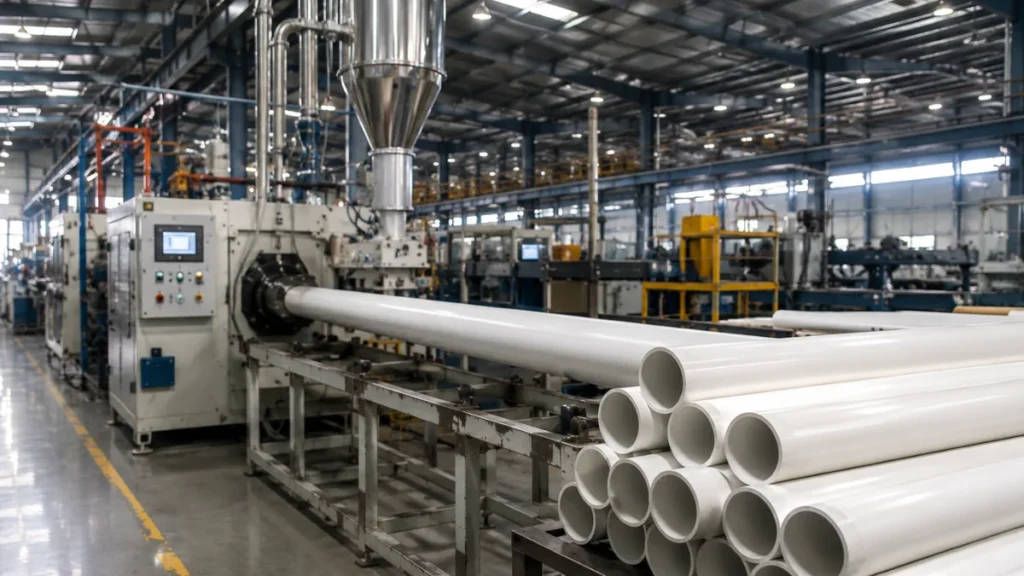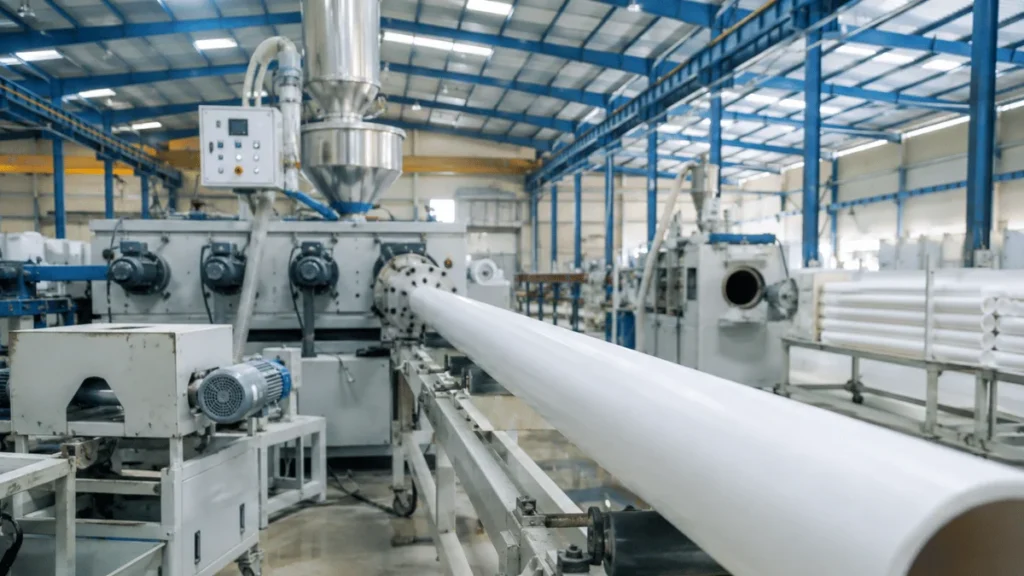

Buying a PVC pipe manufacturing machine is a major investment decision for any factory owner. Before purchasing equipment, manufacturers usually compare production capacity, machine specifications, power requirements, and expected output.
A common expectation is simple:
“A machine specification of 500 kg per hour does not automatically mean the factory will achieve that output continuously during every production hour.”
However, many PVC pipe manufacturers discover that their actual production after installation is lower than the capacity mentioned during machinery selection.
This creates important questions:
- Why is my PVC pipe machine not achieving its expected output?
- Is the machine capacity calculation incorrect?
- What factors reduce actual PVC pipe production?
- Can production be improved without purchasing a bigger machine?
The answer is that machine capacity and actual production output are two different measurements.
A machine’s rated capacity represents what the equipment can achieve under specific operating conditions. Actual factory output depends on many additional factors, including pipe size, raw material quality, tooling condition, process stability, downtime, operator experience, maintenance practices, scrap generation, and downstream operations.
For PVC pipe manufacturers, the real objective should not be running a machine at its highest theoretical speed. The goal should be achieving the highest amount of quality-approved, saleable pipe from every production hour.
Understanding this difference helps manufacturers improve efficiency, plan investments correctly, and avoid unnecessary capacity expansion.
Machine Capacity vs Actual Production Explained
PVC machine capacity refers to the maximum production capability of a machine under defined operating conditions.
It is generally expressed as:
- Kilograms per hour (kg/hour)
- Metres per hour
- Tonnes per day
Actual production output refers to the quantity of finished pipes produced after considering real factory conditions.
The difference can be understood as:
PVC Machine Capacity = Theoretical production capability
Actual Output = Real finished production achieved after production losses
For example:
A PVC pipe extrusion line has a rated capacity of:
500 kg/hour
If the machine runs continuously for 8 hours:
500 × 8 = 4,000 kg theoretical production
But in real production:
- 20 minutes may be consumed during start-up
- Product changeover may take additional time
- Some material may become scrap
- Operators may adjust process parameters
- Quality issues may reduce production speed
- Downstream equipment may not match extrusion output
The final saleable output may become:
3,300–3,600 kg instead of 4,000 kg.
This does not necessarily mean the machine is performing poorly.
The difference comes from the gap between ideal machine conditions and actual factory operations.
Why Does PVC Machine Capacity Differ From Actual Factory Output?
A PVC pipe manufacturing line is not just one machine. It is a complete production system where multiple processes work together.
The extrusion machine, cooling system, haul-off, cutting system, socketing equipment, slotting equipment, operators, raw material, and maintenance practices all influence final output.
The main factors affecting actual PVC pipe production include:
- Pipe diameter and wall thickness
- Product specifications
- Raw material consistency
- Machine settings
- Screw and barrel condition
- Die and tooling accuracy
- Cooling efficiency
- Production planning
- Operator skills
- Downtime
- Scrap and rejection
- Downstream machinery capacity
A factory may have a high-capacity machine but still achieve lower production if one or more supporting processes create limitations.
Why Machine Capacity Mentioned by Manufacturers Is Not Always Equal to Factory Output
One of the most important things machinery buyers should understand is that production capacity is always related to operating conditions.
A machine capacity figure is usually considered under controlled conditions such as:
- Specific pipe diameter
- Specific material formulation
- Stable electricity supply
- Proper cooling system
- Correct tooling
- Continuous operation
- Experienced operators
- Minimum downtime
However, actual factories operate differently.
A manufacturer may produce:
- Multiple pipe sizes
- Different product categories
- Different wall thicknesses
- Different formulations
- Short production batches
- Custom requirements
Each of these factors changes the achievable output.
Therefore, when comparing PVC pipe machinery, buyers should not only ask:
“What is the maximum capacity of this machine?”
They should also ask:
“Under what conditions is this capacity achieved?”
and
“Will this machine match my actual production requirement?”
This approach helps avoid unrealistic production expectations.
1. Pipe Size and Product Requirements Affect PVC Pipe Production Output
One of the biggest reasons behind the difference between machine capacity and actual output is the type of pipe being manufactured.
A PVC extrusion line does not produce the same output for every pipe size.
Production depends on:
- Pipe diameter
- Wall thickness
- Pipe application
- Required standard
- Material formulation
- Cooling requirement
For example:
A machine producing smaller diameter pipes may achieve higher output because less material is required per metre.
The same machine producing larger diameter or heavy-wall pipes may operate at a different production rate because:
- Material consumption increases
- Cooling requirements change
- Process stability becomes more demanding
Therefore, production capacity should always be evaluated according to the actual product range.
A factory producing agricultural pipes, plumbing pipes, pressure pipes, or other specialised products should select machinery based on its own manufacturing requirements rather than only comparing maximum output numbers.
2. Raw Material Quality Directly Influences Production Efficiency
PVC resin is one of the most important inputs in pipe manufacturing, but the final processing behaviour depends on the complete formulation.
PVC pipe production may involve:
- PVC resin
- Stabilizers
- Lubricants
- Processing aids
- Fillers
- Pigments
- Other additives
Variation in raw material quality or formulation consistency can affect production stability.
Possible problems include:
- Unstable extrusion
- Surface defects
- Dimensional variation
- Higher rejection
- More operator adjustments
- Reduced production speed
A factory may have a high-capacity machine, but inconsistent material behaviour can prevent it from achieving stable output.
Manufacturers should focus on:
- Reliable suppliers
- Proper material storage
- Accurate weighing
- Controlled mixing
- Batch identification
- Material traceability
Better material control improves both production efficiency and product consistency.
3. Machine Settings Can Create Hidden Production Losses
PVC extrusion requires a controlled balance between several process parameters.
Important parameters include:
- Barrel temperature
- Die temperature
- Screw speed
- Melt pressure
- Vacuum sizing
- Cooling conditions
- Haul-off speed
- Cutting operation
Small variations in these parameters can affect production quality.
Incorrect settings may lead to:
- Uneven wall thickness
- Surface problems
- Dimensional instability
- Higher scrap
- Reduced production speed
Many manufacturers try to increase output by increasing machine speed.
However, higher speed does not always mean higher efficiency.
If increasing speed creates more rejection, the factory may produce more material but less saleable pipe.
The better approach is maintaining a stable process where the machine produces consistent quality at an efficient operating speed.
4. Tooling Condition Can Reduce PVC Machine Performance
Dies and tooling play a critical role in PVC pipe manufacturing.
Even a well-designed extrusion line can experience production problems if tooling is worn, damaged, contaminated, or improperly maintained.
Tooling issues can affect:
- Pipe dimensions
- Wall thickness
- Material distribution
- Surface quality
- Production stability
Common problems include:
- Die wear
- Improper cleaning
- Alignment issues
- Incorrect maintenance
- Delayed replacement
Sometimes operators compensate for tooling problems by adjusting machine settings.
This may temporarily improve production, but the underlying problem remains.
Regular tooling inspection helps maintain stable output and reduces unnecessary adjustments.
5. Cooling System Performance Affects Actual Production Speed
Cooling is one of the most important stages after extrusion.
After leaving the die, PVC pipe needs controlled cooling to achieve required dimensions and stability.
If cooling is insufficient:
- Production speed may need to be reduced
- Pipe dimensions may vary
- Rejection may increase
Cooling efficiency depends on:
- Water temperature
- Water circulation
- Pump performance
- Cooling tank design
- Heat removal capacity
A production line can only achieve efficient output when extrusion, sizing, cooling, and pulling systems work together properly.
6. Operator Experience and Process Control Influence Actual Production
Even when two factories use similar PVC pipe machinery, their production output can be different.
One major reason is how effectively the machine is operated.
PVC pipe manufacturing requires continuous monitoring and adjustment. Operators need to understand how changes in one area affect the final product.
For example:
- A temperature variation can affect melt stability.
- Incorrect pulling speed can influence dimensions.
- Improper cooling control can create quality issues.
- Delayed adjustment can increase rejection.
Experienced operators can identify early warning signs such as:
- Unusual machine sounds
- Surface changes in pipes
- Variation in dimensions
- Pressure fluctuations
- Cooling problems
However, relying only on individual experience can create inconsistency between shifts.
Factories can improve production stability by developing standard operating procedures for:
- Machine start-up
- Product changeovers
- Process monitoring
- Quality checks
- Shutdown procedures
- Troubleshooting steps
A controlled production process helps factories achieve more consistent output from the same machinery.
7. Downtime Creates a Major Gap Between Machine Capacity and Actual Output
A machine’s rated capacity assumes that the equipment operates continuously.
However, real factories experience interruptions.
Even small stoppages can create significant production losses when they occur repeatedly throughout the day.
Common causes of downtime include:
- Mechanical breakdowns
- Electrical problems
- Material shortages
- Tool changes
- Cleaning activities
- Maintenance work
- Quality adjustments
- Operator availability issues
For example:
A machine capable of producing 500 kg/hour may appear highly productive, but if it loses two hours of production time in a shift, the factory loses 1,000 kg of possible output before considering scrap or rejection.
This is why manufacturers should track downtime scientifically.
Important measurements include:
- Reason for stoppage
- Duration of stoppage
- Frequency of occurrence
- Corrective action taken
The objective should not only be repairing machines after failure. It should be identifying repeated problems and preventing unnecessary production losses.
8. Downstream Machinery Can Become the Real Production Bottleneck
Many manufacturers evaluate only the extrusion machine while planning production capacity.
However, PVC pipe manufacturing involves several stages after extrusion.
Depending on the product, the production line may include:
- Cooling
- Cutting
- Socketing or belling
- Slotting
- Inspection
- Packing
- Material handling
If one downstream operation cannot match extrusion output, it becomes the limiting factor for the entire production system.
For example:
A factory has an extrusion line capable of producing 600 kg/hour, but the socketing operation can process only 400 kg/hour.
The factory cannot fully utilise extrusion capacity because the next process becomes a bottleneck.
This can create:
- Pipe accumulation
- Increased handling
- Additional labour requirement
- Floor-space problems
- Longer production cycles
Before increasing extrusion capacity, manufacturers should evaluate the complete production flow.
Sometimes improving a supporting process can increase total output without purchasing a new extrusion line.
9. Production Planning Has a Direct Impact on Machine Utilisation
A machine may have the technical ability to produce continuously, but poor production planning can reduce effective utilisation.
Common causes include:
- Frequent product changes
- Lack of material preparation
- Delayed tooling availability
- Poor scheduling
- Unplanned maintenance
- Incorrect manpower allocation
For example:
A factory producing many different pipe sizes in short batches may spend significant time on:
- Machine adjustments
- Die changes
- Cleaning
- Trial production
- Quality confirmation
This reduces actual manufacturing hours.
A better production plan considers:
- Product demand
- Pipe sizes
- Tool availability
- Raw material preparation
- Downstream requirements
The goal is not eliminating product variety. The goal is reducing unnecessary production interruptions.
10. Scrap and Rejection Reduce Real Production Efficiency
A factory’s production performance should not be measured only by how much material enters the machine.
The more important measurement is how much acceptable finished pipe reaches customers.
Production losses may occur because of:
- Start-up waste
- Trial material
- Dimensional variation
- Surface defects
- Cutting losses
- Socketing rejection
- Handling damage
- Process instability
A simple example:
A factory processes:
10,000 kg of PVC compound
During production:
700 kg becomes scrap or rejected output
The actual saleable production is:
9,300 kg
The factory has not lost only material. It has also lost:
- Machine time
- Electricity
- Labour
- Maintenance cost
- Production capacity
Reducing avoidable rejection is often one of the fastest ways to improve output without increasing machine capacity.
11. How Scrap Processing Supports Better Material Utilisation
PVC factories generate different types of production scrap.
Examples include:
- Pipe cutting waste
- Start-up material
- Rejected pipes
- Trial production waste
- Processing leftovers
Proper scrap management can help manufacturers recover value from suitable material.
A typical recovery process may involve:
Collection → Sorting → Size Reduction → Evaluation → Suitable Reuse Decision
A PVC scrap grinder is generally used for reducing larger scrap pieces into smaller, manageable sizes.
A pulverizer can be used when a finer material size is required for a particular processing requirement.
However, the correct equipment depends on:
- Scrap type
- Quantity generated
- Required output size
- Material condition
- Production requirement
Factories should remember that scrap processing is not a replacement for preventing unnecessary waste.
The best approach is:
First reduce avoidable scrap, then recover suitable unavoidable scrap.
12. How Can PVC Pipe Manufacturers Calculate Real Production Efficiency?
Instead of focusing only on machine specifications, manufacturers should monitor practical efficiency indicators.
Saleable Production Per Operating Hour
This shows how much finished pipe is produced during actual running time.
Formula:
Saleable output per hour = Accepted finished production ÷ Actual machine operating hours
This is more useful than simply measuring machine speed.
Material Utilisation Efficiency
This indicates how effectively raw material is converted into finished products.
Formula:
Material utilisation (%) = Saleable output ÷ Total material consumed × 100
A lower value indicates higher material loss.
Scrap Percentage
This helps identify production waste.
Formula:
Scrap percentage (%) = Total scrap generated ÷ Total material processed × 100
Tracking scrap by reason helps identify improvement opportunities.
Machine Availability
This metric helps manufacturers understand the percentage of scheduled operating hours that are genuinely available for production.
Formula:
Machine availability (%) = Actual running time ÷ Planned production time × 100
Improving availability can increase production without changing machine capacity.
13. How to Calculate the Right PVC Machine Capacity Before Buying?
Choosing the correct machine capacity is one of the most important decisions for a PVC pipe manufacturer.
Many buyers make the mistake of selecting machinery based only on the highest output figure.
A more practical method is to identify the factory’s expected production volume, operating conditions, and future requirements before selecting machinery.
Consider:
Step 1: Monthly Production Requirement
Example:
Required production:
100 tonnes/month
Step 2: Working Days
Factory operates:
25 days/month
Daily requirement:
100 tonnes ÷ 25 days
= 4 tonnes/day
Step 3: Production Hours
Factory operates:
8 hours/day
Hourly requirement:
4,000 kg ÷ 8 hours
= 500 kg/hour
However, practical planning should also consider:
- Downtime
- Maintenance
- Product changes
- Future growth
- Seasonal demand
A machine should not be selected only for today’s requirement.
It should support realistic future business plans.
14. Why Buying the Highest Capacity Machine Is Not Always the Best Decision
A higher-capacity machine may appear attractive because it promises more production.
However, higher capacity can also mean:
- Higher investment
- Higher power requirement
- More space requirement
- Greater maintenance responsibility
- Higher raw material requirement
- Additional labour needs
If the market demand does not support that production level, the factory may have unused capacity.
The correct question is not:
“Which is the biggest machine available?”
The correct question is:
“The right machine capacity should be chosen by evaluating your production targets, product requirements, available resources, and long-term business expansion plans.”
A suitable machine should balance:
- Production requirement
- Product range
- Investment capacity
- Operating cost
- Future expansion
15. How Can Manufacturers Increase PVC Pipe Output Without Increasing Machine Capacity?
Before investing in additional machinery, factories should analyse existing production losses.
Many output improvements come from better utilisation of current resources.
Reduce Unplanned Downtime
Identify repeated failures and solve the underlying cause.
Improve Preventive Maintenance
Regular inspection of:
- Extrusion components
- Motors
- Gearbox
- Heating system
- Cooling system
- Dies
- Cutting units
- Socketing equipment
- Scrap processing machines
helps maintain stable operation.
Reduce Changeover Losses
Prepare:
- Tools
- Raw materials
- Machine settings
- Operators
before production interruption.
Improve Quality Monitoring
Early detection of problems reduces large rejection batches.
Balance Production Stages
Ensure extrusion, socketing, slotting, inspection, and packing support each other.
16. What Should Manufacturers Check Before Buying PVC Pipe Machinery?
Before investing in machinery, buyers should evaluate more than the machine price.
Important factors include:
Production Requirements
- Pipe diameter range
- Pipe application
- Expected output
- Working hours
- Future expansion plans
Technical Requirements
- Material compatibility
- Machine capacity under actual conditions
- Automation level
- Power requirement
- Maintenance needs
Factory Conditions
- Available space
- Labour availability
- Installation requirements
- Utility availability
Supplier Support
Consider:
- Manufacturing experience
- Technical guidance
- Installation assistance
- Spare parts availability
- After-sales support
A machinery supplier should understand the manufacturer’s actual requirements before suggesting equipment.
17. How Dass Engineering Supports PVC Pipe Manufacturers
Selecting industrial machinery is not only about purchasing equipment. It is about choosing a solution that matches production requirements.
Dass Engineering Pvt Ltd has manufacturing experience since 1975 and provides machinery solutions for PVC processing applications.
The company’s product range includes:
- PVC and CPVC scrap grinders
- Pulverizers
- Manual, semi-automatic and automatic socketing machines
- Pipe slotting machines
- Plastic pipe die mould solutions
For manufacturers evaluating a Leading PVC pipe machinery manufacturer in India, important information to share includes:
- Pipe size range
- Production requirement
- Raw material type
- Automation preference
- Available power supply
- Factory space
- Delivery location
This helps identify machinery that meets actual production requirements rather than selecting equipment based solely on theoretical capacity.
Final Thoughts
The gap between PVC machine capacity and actual output is one of the most important factors affecting factory profitability.
A machine may have excellent technical specifications, but real production depends on how efficiently the entire manufacturing system works together.
Factors such as:
- Raw material consistency
- Machine settings
- Tooling condition
- Cooling efficiency
- Operator skills
- Downtime control
- Scrap reduction
- Downstream balancing
- Production planning
All influence final output.
The goal of a PVC pipe manufacturer should not simply be running machinery faster.
The goal should be to convert every production hour and kilogram of raw material into the highest quality, approved finished pipe.
Before investing in additional capacity, manufacturers should first identify hidden production losses and improve existing processes.
A well-managed production system can often achieve significantly better output from the machinery already installed.
Frequently Asked Questions
Why is my PVC pipe machine producing less than the mentioned capacity?
The difference usually occurs because rated capacity is measured under specific conditions. Actual output depends on pipe size, raw material, machine settings, downtime, tooling, cooling, operator skills, scrap, and downstream processes.
How can I improve PVC pipe production without buying a bigger machine?
Manufacturers can improve output by reducing downtime, controlling scrap, improving maintenance, shortening changeovers, stabilising processes, and balancing downstream operations.
Does a higher-capacity PVC machine always provide better production?
Not necessarily. A higher-capacity machine is useful only when production demand, infrastructure, labour, and downstream processes can support it.
What factors affect PVC pipe machine output?
Major factors include pipe size, material quality, tooling condition, cooling system, machine maintenance, operator experience, production planning, and quality control.
How should I select PVC pipe machinery capacity?
Select capacity based on actual production requirements, product range, working hours, future growth plans, available resources, and operating conditions.
Can a factory increase output without changing the machine?
Yes. Improving process stability, reducing downtime, lowering rejection, improving material utilisation, and removing bottlenecks can increase effective output from existing machinery.