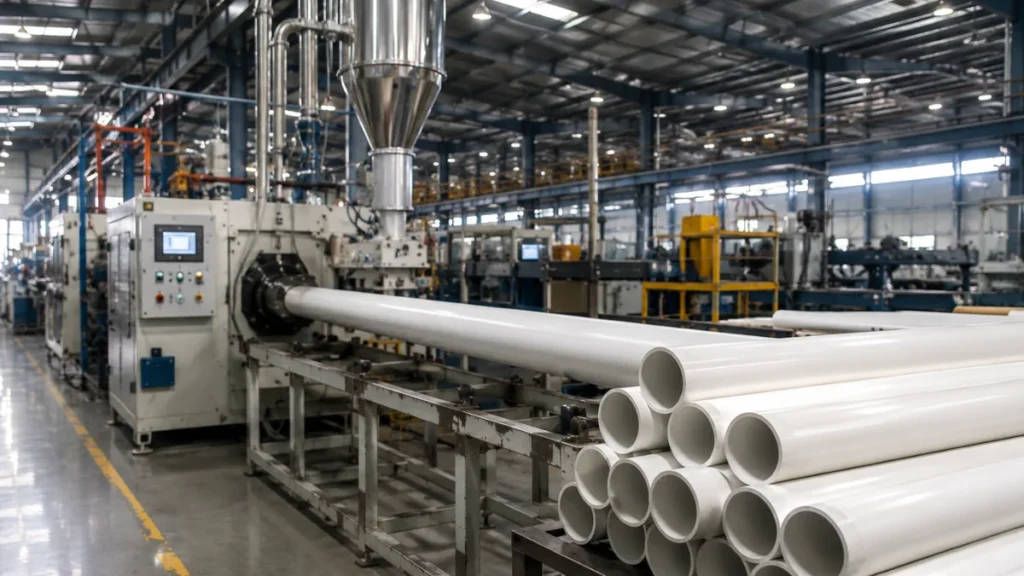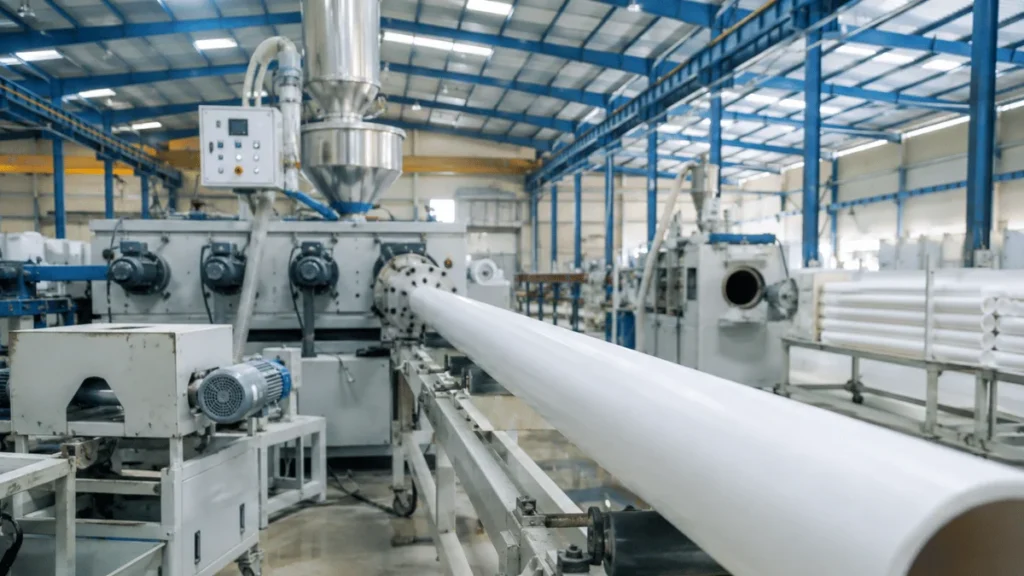

Extrusion produces the basic PVC pipe, but it does not always produce the final product that is ready for sale or installation. Depending on the application, an extruded pipe may still require socketing for joining, slotting for filtration or water-entry applications, and inspection before packing. At the same time, start-up waste, off-cuts, rejected pipes, and other suitable production scrap need an organized handling process.
This is where downstream machinery becomes an important part of PVC pipe production.
Socketing machines form pipe ends according to the required joining system. Slotting machines create controlled openings for specific pipe applications. Scrap grinders and pulverizers perform different stages of size reduction when suitable production waste needs to be processed.
However, every factory does not require all of these machines. The correct downstream setup depends on the products being manufactured, pipe sizes, production volume, raw material, available power, labour, factory space, and how production scrap will be handled.
What Happens After PVC Pipe Extrusion?
During extrusion, prepared PVC compound is converted into a continuous pipe profile. The pipe is formed through a die, sized, cooled, pulled through the line, and cut to the required length.
What happens after cutting depends on the finished product.
A plain pipe may proceed almost directly to quality inspection and packing. A pipe designed for socket joining requires an additional forming operation at one end. Filter or borewell pipes may need precisely arranged slots. Scrap generated during start-up, cutting, size changes, or rejection is separated from finished production and handled through an appropriate recovery process.
Downstream operations therefore have three distinct purposes:
- Socketing: forming the pipe end according to its required joining system.
- Slotting: creating controlled openings for application-specific pipes.
- Scrap processing: reducing suitable production waste into a manageable or finer form for further handling or processing.
Understanding these differences helps a factory invest only in equipment that serves an actual production requirement.
How Does PVC Pipe Socketing Work?
Socketing, also referred to as belling in certain pipe applications, forms an enlarged section at one end of a finished pipe. This allows the pipe to connect according to its intended joining arrangement.
The operation begins after the pipe has been extruded and cut. The required portion of the pipe end is heated until it reaches suitable forming conditions. Appropriate tooling then shapes the softened end into the required socket profile. After forming, the socket is stabilized before the finished pipe moves to inspection.
The basic process involves:
- Positioning the cut pipe.
- Heating the required portion of the pipe end.
- Forming the softened end using suitable tooling.
- Stabilizing the newly formed socket.
- Releasing the pipe for inspection and further handling.
Heating and forming conditions need to remain controlled. Incorrect heating or unsuitable tooling can affect socket dimensions, shape, and fit.
Also Read: How to Start a PVC Manufacturing Company in India
Plain Socketing vs SWR Socketing
Not every PVC pipe uses the same socket profile.
Plain pipes and SWR pipes can have different joining requirements, which means their tooling and machine configurations may also differ. The machine should therefore be selected around the actual product rather than assuming one socket arrangement is appropriate for every pipe.
An SWR Pipe Socketing Machine, for example, should match the required SWR pipe diameter range and socket configuration.
Factories producing several pipe diameters should also evaluate changeover requirements. If production regularly moves between sizes, the accessibility of tooling and the time required for setup can influence practical output during a shift.
How to Choose the Right PVC Pipe Socketing Machine
Machine selection should begin with your finished pipe specification.
Before requesting a quotation for a PVC pipe socketing machine, define:
- Pipe material
- Minimum and maximum diameter
- Pipe length
- Required socket profile
- Expected production volume
- Number of sizes produced regularly
- Available electrical power
- Labour availability
- Factory floor space
- Preferred automation level
Manual, semi-automatic, and more automated machines can suit different production environments.
A plant manufacturing high volumes of similar pipes may benefit from a different level of automation than a smaller unit frequently changing between pipe sizes. Automation should therefore be selected according to actual production conditions rather than treated as an advantage by itself.
What Is PVC Pipe Slotting?
Slotting has a completely different purpose from socketing.
Instead of modifying the end of a pipe, a PVC pipe slotting machine creates controlled openings along selected areas of an already manufactured pipe. These slots allow water or other fluids to pass through the pipe wall where the product design requires it.
Slotted pipes may be used in borewell, filtration, drainage, and other application-specific systems.
The required slot width, length, spacing, quantity, and pattern depend on the finished product. This means slotting performance should not be evaluated only by machine speed. The machine must also produce the required slot configuration consistently across the intended pipe range.
Does Every PVC Pipe Factory Need a Slotting Machine?
No. Slotting is an application-specific operation.
A manufacturer producing standard plumbing, agricultural, conduit, or other plain pipes may not require slotting equipment. A factory producing filter or slotted casing pipes may consider it an important downstream process.
Before selecting a plastic pipe slotting machine, determine:
- Pipe diameter range
- Maximum pipe length
- Required slot dimensions
- Slot pattern and spacing
- Expected production quantity
- Pipe material
- Desired operating speed
- Automation requirement
Defining these parameters before purchasing helps avoid paying for capacity or functions that the factory does not actually require.
You May Like: Is PVC Pipe Manufacturing Profitable?
Where Does Scrap Come From in PVC Pipe Production?
Even a well-controlled manufacturing line can generate production scrap.
Waste may arise during extrusion start-up, machine adjustments, pipe-size changes, cutting, socketing trials, damaged production, or quality rejection.
Typical sources include:
- Start-up material
- Pipe off-cuts
- Rejected pipes
- Damaged finished pipes
- Trial pieces
- Size-change waste
Proper segregation should come before size reduction. Clean in-house production scrap should be separated from contaminated material or waste of uncertain composition.
Suitable segregated material can then be processed according to the factory’s recovery or material-handling requirements.
What Does a PVC Scrap Grinder Do?
A PVC scrap grinder machine is used for coarse size reduction.
Long rejected pipes, large off-cuts, and bulky PVC waste can be difficult to store, transport, or feed into subsequent processing equipment. A grinder reduces this material into smaller and more manageable pieces.
The machine should be selected according to the actual scrap being generated rather than only its advertised capacity.
Important factors include:
- Type of scrap
- Maximum scrap dimensions
- Approximate quantity generated per shift
- Required output size
- Motor capacity
- Rotor and blade construction
- Feeding arrangement
- Discharge system
- Blade maintenance requirements
Installing a much larger grinder than the factory needs can increase investment and connected electrical load without necessarily improving the overall production workflow.
PVC Scrap Grinder vs Pulverizer: What Is the Difference?
A PVC scrap grinder and a pulverizer are both used in material processing, but they perform different levels of size reduction.
A PVC scrap grinder is designed to handle relatively bulky material such as rejected pipes, cut pieces, start-up waste, and other larger production scrap. Its job is to reduce this material into smaller pieces that are easier to store, handle, feed, or process further.
A PVC pulverizer machine is used when suitable pre-sized material needs to be reduced into a much finer form. Large pipe sections are therefore generally reduced before material is sent for pulverizing.
In practical terms, large PVC scrap is first passed through a grinder to convert it into smaller, manageable pieces. If the production process requires a finer material, those pieces can then undergo further size reduction in a pulverizer.
The main distinction is straightforward: a grinder performs coarse size reduction, while a pulverizer performs finer size reduction.
A factory may need only grinding if smaller pieces are sufficient for its intended process. Where finer material is required, grinding may be followed by pulverizing. The correct arrangement depends on scrap type, feed size, required final material size, production volume, and how the processed material will be used afterward.
Disc vs Hammer Pulverizer: What Should a Factory Consider?
Pulverizers can use different operating designs, including disc and hammer-type configurations. Selecting between them should be based on the material and processing requirement rather than only motor horsepower or quoted output.
Before selecting a pulverizer, consider:
- Material to be processed
- Feed size
- Required final fineness
- Expected hourly capacity
- Motor requirement
- Cooling arrangement
- Wear-component quality
- Cleaning requirements
- Maintenance accessibility
If a factory processes different formulations or operates for long production shifts, these factors become particularly important when comparing equipment.
Can Processed PVC Scrap Be Reused?
Suitable clean in-house PVC production scrap may sometimes be processed for reuse, but grinding or pulverizing does not automatically make waste suitable for every pipe product.
Manufacturers need to consider where the scrap originated, its formulation, possible contamination, material consistency, the intended finished product, and applicable quality requirements.
The acceptable use of reprocessed material should therefore be determined for the specific product and manufacturing standard. Applying one fixed recycled-material percentage across different pipe categories can create unnecessary quality risks.
How Should Downstream Capacity Match Extrusion Output?
Capacity matching is important because downstream equipment should support the production line rather than create a bottleneck.
If extrusion produces pipes faster than a socketing operation can finish them, semi-finished products begin accumulating. On the other hand, installing downstream equipment with far more capacity than the factory can use may unnecessarily increase investment.
Factories should estimate:
- Number of pipes produced per shift
- Percentage requiring socketing
- Quantity requiring slotting
- Frequency of product changes
- Amount of scrap generated
- Number of operating shifts
- Expected future production growth
The objective is not to give every machine the same rated output. It is to create a production flow in which each stage has enough capacity for the work it actually needs to perform.
Power, Space and Labour Requirements
Downstream machinery also needs to fit the physical and operating conditions of the factory.
Power requirements depend on the machine model, motor size, heating system, processing capacity, and auxiliary equipment. Factory planning should consider not only the machine footprint but also pipe loading and unloading areas, scrap storage, operator movement, electrical access, and maintenance space.
Labour requirements vary with automation. More automated equipment can reduce certain repetitive handling tasks, while manual or semi-automatic machines may offer practical flexibility for smaller production volumes or frequent product changes.
The right choice depends on production volume, workforce availability, budget, and operating pattern.
What Determines Downstream Machinery Price?
There is no single price that applies to every socketing machine, slotting machine, grinder, or pulverizer.
The final machine cost may vary according to:
- Processing capacity
- Pipe diameter or scrap dimensions
- Machine configuration
- Motor and component selection
- Tooling
- Automation level
- Customization
- Scope of supply
- Taxes
- Transportation
- Installation requirements
Instead of focusing only on the quoted price, compare the complete configuration and what it is designed to achieve. Machine construction, components, tooling, power requirements, maintenance needs, spare-part availability, installation support, warranty, and after-sales assistance all contribute to long-term operating value.
Maintenance Requirements to Consider Before Buying
Maintenance requirements should be understood before machinery enters the factory.
Socketing equipment may require periodic inspection of heating elements, tooling, alignment, forming components, and moving parts. Slotting machines require attention to cutting components and positioning mechanisms. Scrap grinders and pulverizers require inspection of blades, discs, hammers, bearings, screens, or other wear components according to machine design.
A practical preventive maintenance routine includes regular cleaning, lubrication where specified, inspection of wear parts, alignment checks, and timely replacement of components.
Buyers should also confirm how easily commonly required spare and wear parts can be obtained.
Questions to Ask Before Placing an Order
A technical discussion with a PVC pipe machinery manufacturer in India should go beyond machine price.
Ask:
- Can the machine handle every specified pipe size or scrap type?
- What output can reasonably be expected for the intended product?
- Which tooling is included?
- What electrical load is required?
- How are product-size changes handled?
- Which components require routine replacement?
- What operator involvement is required?
- Can the machine be customized?
- What installation or commissioning support is available?
- How are spare parts supplied?
- What warranty and after-sales assistance are included?
Providing complete production information also helps the manufacturer recommend a more appropriate machine configuration.
Bringing the Downstream Process Together
Socketing, slotting, grinding, and pulverizing should not be viewed as interchangeable additions to an extrusion plant. Each performs a specific function.
Socketing prepares the pipe end for the intended joining system. Slotting creates application-specific openings in finished pipes. Grinding reduces bulky production scrap, while pulverizing provides further size reduction when finer material is required.
A factory may need only one of these operations or several of them.
The most practical production line is therefore not the one with the greatest number of machines. It is the one where every machine has a defined purpose and its capacity, utilities, labour requirement, and operating method fit the overall production plan.
Conclusion
Completing a PVC pipe production line requires looking beyond extrusion. Once the pipe has been formed, sized, cooled, and cut, its intended application determines whether additional downstream processing is necessary.
Socketing provides the required pipe-end configuration for joining. Slotting creates controlled openings for selected applications. Scrap grinders and pulverizers help factories handle suitable production waste through different stages of size reduction.
Choosing these machines requires an understanding of pipe diameter, product type, output, scrap volume, automation, available electrical power, factory space, maintenance, tooling, and after-sales requirements.
Dass Engineering Pvt Ltd has manufacturing experience since 1975 and produces socketing machines, slotting machines, PVC scrap grinders, disc and hammer pulverizers, and related machinery for PVC, CPVC, HDPE, and PET processing applications.
Businesses evaluating a Top PVC Pipe Machinery Manufacturer in India can share their pipe material, diameter range, required production capacity, socket or slot specifications, expected scrap quantity, automation preference, available electrical load, factory space, and delivery location with Dass Engineering Pvt Ltd. This information helps determine a machinery configuration based on actual production requirements rather than a standard one-size-fits-all setup.
Frequently Asked Questions
1. What machinery may be required after PVC pipe extrusion?
The requirement depends on the finished pipe. A factory may need socketing or belling equipment, a slotting machine, and scrap-processing machinery in addition to inspection and handling equipment. Not every PVC pipeline requires all of these machines.
2. What is the difference between PVC pipe socketing and slotting?
Socketing forms the end of a pipe according to its joining requirement. Slotting creates controlled openings along the pipe for applications such as filtration, borewell, or drainage systems.
3. Is a PVC scrap grinder the same as a pulverizer?
No. A scrap grinder performs coarse size reduction by converting larger PVC waste into smaller pieces. A pulverizer performs further size reduction when a finer material is required.
4. Does PVC scrap need to be ground before pulverizing?
When the available scrap consists of large pipe sections or bulky pieces, it normally needs to be reduced to a suitable feed size before pulverizing. The exact preparation requirement depends on the pulverizer design and material being processed.
5. Can processed PVC production scrap be reused?
Suitable clean in-house scrap may be reused where the formulation, product specification, applicable standards, and quality requirements permit it. Manufacturers should determine suitability for the particular product instead of assuming that all processed PVC waste can return to production.
6. How should a factory select downstream machinery capacity?
Capacity should be based on actual extrusion output, pipe sizes, percentage of production requiring socketing or slotting, number of shifts, scrap generation, product-change frequency, and expected future requirements. The objective is to prevent bottlenecks without investing unnecessarily in unused capacity.