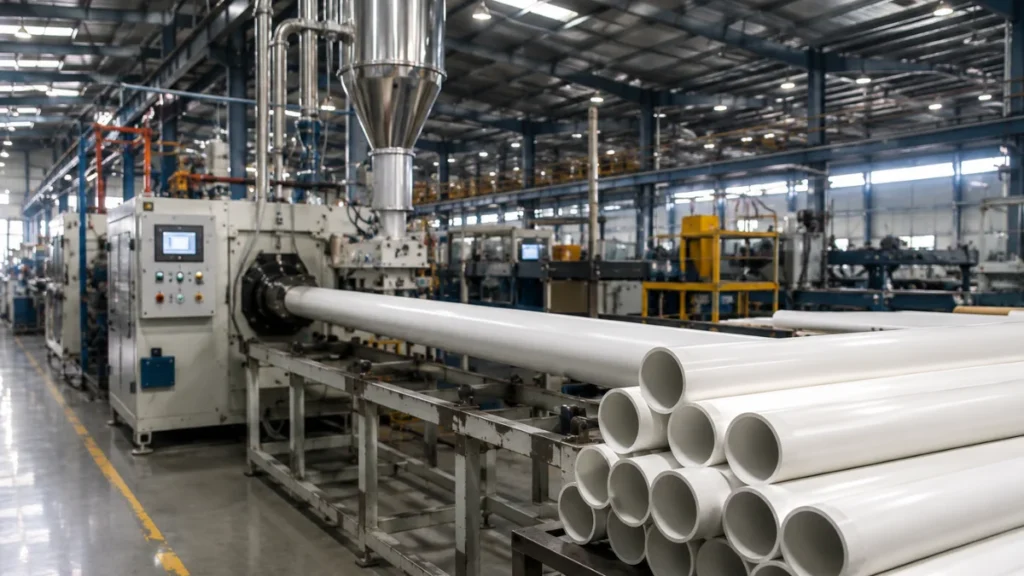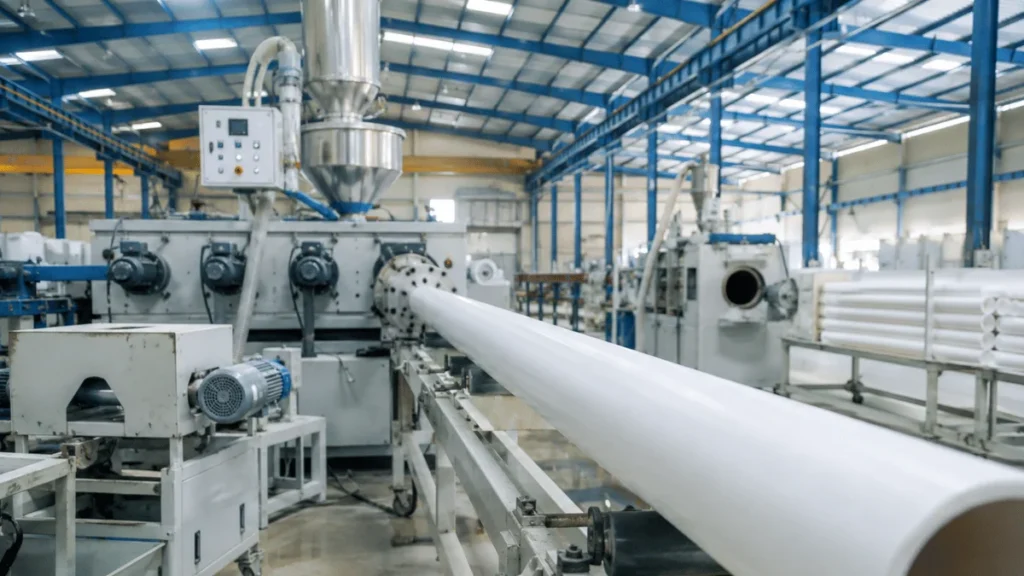

PVC pipe manufacturing generates scrap during cutting, production start-up, finishing, and quality inspection. Pipe offcuts, rejected products, and damaged profiles can accumulate quickly, creating additional material-handling work and taking up valuable factory space. A suitable plastic scrap grinder machine can reduce compatible waste into smaller pieces, making it easier to handle and potentially suitable for further processing.
However, choosing the right grinder requires more than comparing machine prices or advertised capacity. The equipment must match the type of scrap, the dimensions of incoming material, the required particle size, and the quantity that needs to be processed within the available operating hours.
For manufacturers researching a plastic scrap grinder machine supplier, understanding these factors can help prevent unsuitable purchases and unnecessary operating expenses. This guide explains how to assess scrap characteristics, calculate capacity requirements, evaluate machine specifications, and determine whether the processed material is appropriate for reuse.
Read This: Is PVC Pipe Manufacturing Profitable?
What Is a Plastic Scrap Grinder Machine?
A plastic scrap grinder processes compatible plastic waste by breaking it down into smaller pieces through a mechanical grinding process. Depending on its design, the equipment may use rotating and stationary blades or a hammer-type mechanism.
During operation, scrap enters the grinding chamber and is reduced in size. Some machines use screens to help control the size of discharged material. The resulting particles, commonly called regrind, can then be collected for storage, inspection, or further processing.
Grinding does not automatically make plastic waste suitable for reuse in manufacturing. The material must still be assessed for contamination, composition, particle size, and compatibility with the intended application.
For PVC manufacturers, the objective is to select equipment that handles the actual waste stream at a practical rate while meeting the requirements of the next processing stage.
Also Read: How to Start a PVC Manufacturing Company in India
How to Match the Grinder to Your Plastic Waste Type
The first step in choosing a grinder is identifying the material it will process. Different scrap types behave differently inside the grinding chamber, and their dimensions can affect feeding, cutting performance, and throughput.
For example, short pipe offcuts may be easier to feed than long, thick-walled sections. Irregular profiles can also require a different feeding arrangement from conventional pipe scrap.
Common types of manufacturing waste include:
- PVC pipe offcuts: Sections remaining after pipes are cut to length.
- Rejected pipes: Products that fail dimensional or quality checks.
- Start-up scrap: Material generated while a production line is being stabilised.
- PVC profiles: Irregularly shaped sections that may require particular attention to feeding.
- Mixed or contaminated scrap: Material that needs sorting before it enters the grinder.
Before purchasing, check the maximum input dimensions and material thickness that the machine can accommodate. Do not assume that a high hourly capacity means the grinder can accept every pipe diameter or length.
Material segregation is equally important. Rigid PVC, flexible PVC, CPVC, and other plastics should not automatically be combined for reprocessing because their formulations and intended applications may differ. Removing unsuitable materials and contaminants helps protect equipment and maintain the quality of recovered material.
You May Like: How Socketing, Slotting, and Scrap Processing Complete a PVC Pipe Production Line
PVC Scrap Grinder vs PVC Pulverizer: Which Machine Do You Need?
A PVC scrap grinder and a pulverizer perform different size-reduction tasks. A grinder generally reduces larger plastic waste into smaller pieces, whereas a pulverizer produces finer material when the downstream application requires it.
Consider a factory generating pipe offcuts that need to be reduced before further processing. A suitable scrap grinder may meet that requirement. If the following production step calls for finely powdered PVC, the material may need to pass through a dedicated pulverizer.
The correct choice depends on the required material at the end of the process.
- Choose a grinder when the objective is to reduce larger pieces of plastic scrap.
- Consider a pulverizer when a finer, powder-like output is required.
- Evaluate a multi-stage system only when the production requirements justify the additional equipment and operating costs.
Selecting a machine that produces finer material than necessary can increase energy consumption and processing costs without providing a useful advantage. Establish the downstream particle-size requirement before comparing equipment.
Read More: Why PVC Pipe Factories Are Focusing More on Scrap Recovery and Recycling
How to Calculate the Required Grinder Capacity
Plastic scrap grinder capacity is generally expressed in kilograms per hour (kg/hr). However, practical throughput depends on the scrap type, incoming dimensions, machine design, screen selection, blade condition, and feeding method.
First, work out the total amount of scrap requiring processing and determine how many operating hours can be allocated to the task.
For example, a factory may need to process 600 kg of PVC scrap each day but have only three hours allocated to grinding. Its initial processing target would be:
Required processing rate = 600 kg ÷ 3 hours = 200 kg/hr.
This is a planning estimate, not a guarantee that a grinder rated at 200 kg/hr will achieve that output with the factory’s material. Loading, cleaning, interruptions, and variations in scrap characteristics can reduce effective throughput.
Before selecting a machine, consider:
- Daily and peak scrap generation
- Available grinding hours
- Pipe dimensions and wall thickness
- Required particle size
- Time needed for cleaning and maintenance
- Expected changes in production volume
Ask the supplier to explain the conditions behind its capacity specification. Where possible, request a demonstration or documented evaluation using representative scrap. This provides a more useful basis for comparison than motor horsepower or advertised capacity alone.
Read More: PVC Resin Price Trend in India 2026: What Pipe Manufacturers Should Know
How Do Output Size, Motor Power, and Blade Design Affect Performance?
The required output size should be established before selecting a machine. Smaller particles are not always preferable because finer grinding may require additional processing energy and generate more dust.
Where a screen is fitted, its openings influence which particles can pass through the grinding chamber. Smaller openings may require additional cutting and affect throughput. The resulting particle distribution also depends on machine design, material properties, feeding consistency, and blade condition.
Motor power is important, but it should be evaluated alongside the cutting mechanism, chamber dimensions, and feeding arrangement.
When comparing machines, pay attention to the following:
- Motor and electrical requirements: Confirm the connected load, power supply, and intended operating conditions.
- Blade design and maintenance: Ask about inspection intervals, sharpening or replacement, and spare-part availability.
- Grinding chamber: Check whether the machine can accommodate your regular scrap dimensions.
- Screen options: Select a screen that suits the requirements of the next processing stage.
- Dust and heat management: Review the manufacturer’s recommendations for ventilation, dust control, and safe operation.
Grinding operations can generate airborne particles, so appropriate containment, housekeeping, and dust-control arrangements should be considered during installation and operation.
Can Ground PVC Scrap Be Reused in Pipe Manufacturing?
Ground PVC scrap may be suitable for reuse, but grinding alone does not establish its quality or compatibility with a new product. Manufacturers must assess the material’s composition, cleanliness, processing history, and suitability for the intended formulation.
Before introducing regrind into production, check:
- Whether the scrap comes from a known and compatible material stream
- Whether it contains dirt, metal, or mixed polymers
- Whether its particle size is appropriate for the next process
- Whether the intended formulation permits recycled material
- Whether the finished product can meet the applicable specifications
There is no universal regrind percentage suitable for every PVC pipe or fitting. The appropriate proportion depends on the compound, product design, processing conditions, and quality requirements.
Where a product must comply with specific performance standards, manufacturers should validate the formulation and finished-product properties before introducing reprocessed material. If the material’s identity or history is uncertain, it should not be assumed suitable simply because it has been ground.
Read More: The Production Gaps Hidden Between PVC Machine Capacity and Actual Output
What Should You Check When Choosing a Plastic Scrap Grinder Machine Supplier?
Choosing a plastic scrap grinder machine supplier involves assessing technical suitability, operating requirements, and ongoing support—not just comparing quotations. Before requesting a recommendation, prepare details about the scrap you generate, its dimensions, your expected processing volume, and the output size you require.
Ask prospective suppliers to clarify:
- Maximum input dimensions and expected throughput
- Available screen sizes and output characteristics
- Motor power and electrical requirements
- Blade and screen inspection intervals
- Safe procedures for clearing blockages and maintaining the machine
- Spare-parts availability and technical support
- Installation requirements and operating space
- Whether performance can be evaluated using representative scrap
The total cost of ownership also deserves attention. Electricity, blade maintenance, labour, downtime, and material handling all contribute to the expense of operating a grinder. A machine with a lower purchase price may not be the more economical option over its working life.
When researching a Top PVC Pipe Machinery Manufacturer in India, manufacturers should also examine whether the proposed equipment suits their production requirements, whether technical specifications are clearly documented, and what maintenance support is available. These factors are more useful for evaluating machinery than a general ranking or promotional claim.
An example of published machine specifications
DASS Engineering Private Limited publishes specifications for different scrap-grinding configurations. Its hammer-type PVC scrap grinder is listed with a capacity of up to 200 kg/hr, a 40 HP motor, a 24 × 24-inch chamber, and 10 mm or 12 mm screen options. Its rotator-type scrap grinder is listed in capacity options ranging from 100 to 1,200 kg/hr, depending on the model.
These are published product specifications, not guaranteed output rates for every application. The two machine types have different configurations, and the suitable choice depends on the material being processed and the factory’s requirements.
When comparing any machinery supplier, request model-specific information and establish the conditions under which the stated throughput can be achieved. This helps you evaluate equipment against actual production needs rather than relying on headline figures.
Buying a Plastic Scrap Grinder Machine in Patna
Manufacturers searching for a plastic scrap grinder machine in Patna should assess machine specifications alongside practical purchasing arrangements. Delivery, installation, access to spare parts, and technical assistance may influence how easily the equipment can be integrated into an existing factory.
Before committing to a purchase, confirm the model’s specifications, electrical requirements, warranty conditions, delivery arrangements, and available service support directly with the supplier. Local installation or servicing should not be assumed unless it has been confirmed.
A useful comparison should establish whether the machine can process your particular scrap type at a suitable rate, whether it fits the available factory space, and whether its maintenance requirements are manageable for your team.
Frequently Asked Questions
1. What is the main purpose of a plastic scrap grinder machine?
It reduces suitable plastic waste, including PVC pipe offcuts and rejected products, into smaller pieces for easier handling and potential further processing.
2. How do I calculate the required grinder capacity?
Divide the quantity of scrap that needs processing by the available grinding hours. Then account for interruptions, material dimensions, output size, and peak waste generation. Confirm the practical throughput with the supplier.
3. Does higher motor power guarantee better grinding performance?
No. Performance also depends on the cutting mechanism, chamber dimensions, screen selection, feeding arrangement, and characteristics of the material being processed.
4. Can all ground PVC scrap be reused?
No. Reuse depends on material identity, contamination, formulation compatibility, and the requirements of the intended product. Some applications require additional testing before regrind can be used.
5. What should I check before purchasing a plastic scrap grinder?
Evaluate the scrap type, input dimensions, required output size, expected throughput, electrical requirements, maintenance needs, safety arrangements, spare parts, and technical support.
6. What should I consider when looking for a plastic scrap grinder machine in Patna?
Compare the machine’s specifications, delivery arrangements, installation requirements, warranty conditions, and confirmed service availability. Verify that the selected model can process your actual scrap at the required rate.
Conclusion
Choosing a plastic scrap grinder begins with understanding the waste your factory generates and the material you need after grinding. Scrap type, input dimensions, required particle size, processing capacity, maintenance requirements, and downstream quality standards all influence equipment suitability.
Before purchasing, calculate the processing requirement, compare documented specifications, and verify expected performance using representative material. Establish whether the resulting regrind is appropriate for the intended manufacturing process before introducing it into production.
Whether you are comparing a plastic scrap grinder machine supplier or researching a plastic scrap grinder machine in Patna, prioritise technical suitability, verified specifications, and long-term operating requirements. A well-matched grinder can make scrap handling more manageable when it is integrated into an appropriate material-recovery process.