
Planning to start a PVC pipe manufacturing business or expand an existing production facility? One of the first decisions is understanding how much machinery investment your manufacturing requirements will involve.
The PVC pipe making machine price in India depends on several factors, including production capacity, pipe diameter, extrusion technology, automation, tooling, and the number of machines required. A basic extrusion setup and a complete production facility with mixing, cooling, cutting, socketing, and scrap-processing equipment have very different investment requirements.
Another important consideration is that the price of an individual machine does not represent the cost of an entire PVC pipe manufacturing plant. Buyers must evaluate the complete production arrangement before finalising their budget.
This guide explains machinery costs, available equipment, additional investment requirements, and practical ways to select machinery without spending unnecessarily.
1. What Is the PVC Pipe Making Machine Price in India?
There is no universal price for a PVC pipe making machine because manufacturers offer different configurations for different production requirements.
A machine designed for smaller pipe dimensions may require different tooling and processing arrangements from equipment intended for larger-diameter pipes. Similarly, automatic machinery generally has different control and operating systems from manual or semi-automatic equipment.
The major factors influencing the PVC pipe manufacturing machine cost include:
- Production capacity: Required output per hour and operating schedule.
- Pipe dimensions: Diameter, wall thickness, and pipe length.
- Automation: Manual, semi-automatic, or automatic operation.
- Extrusion configuration: Extruder type, screw design, and processing requirements.
- Tooling: Die heads, die moulds, and sizing components.
- Downstream equipment: Vacuum calibration, cooling, haul-off, and cutting arrangements.
- Customization: Special product dimensions and application-specific requirements.
Consequently, buyers should compare complete machine specifications rather than relying exclusively on advertised prices.
Read This: AI in PVC Pipe Manufacturing: Quality Control and Efficiency
2. What Machines Are Required for a PVC Pipe Manufacturing Plant?
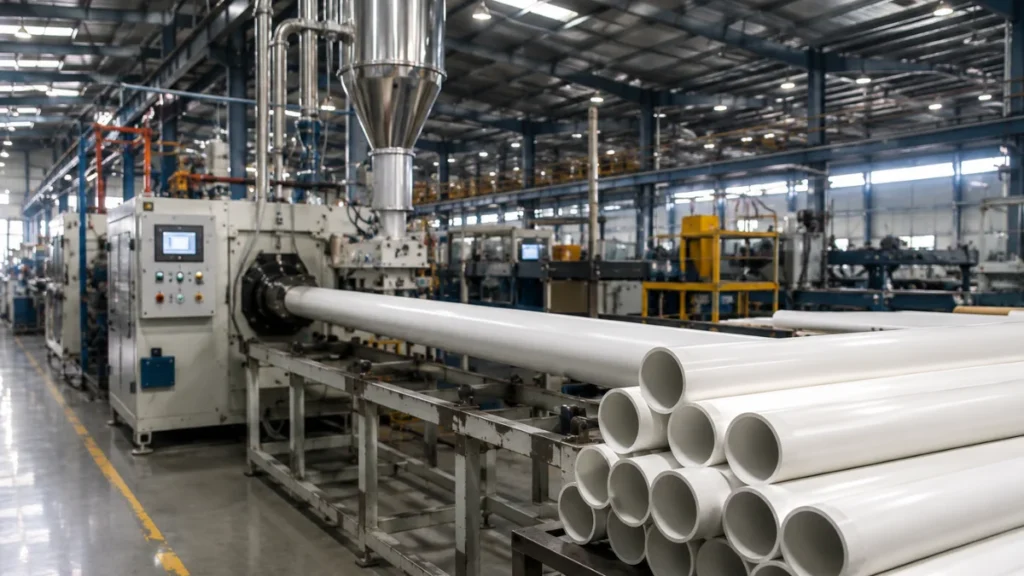
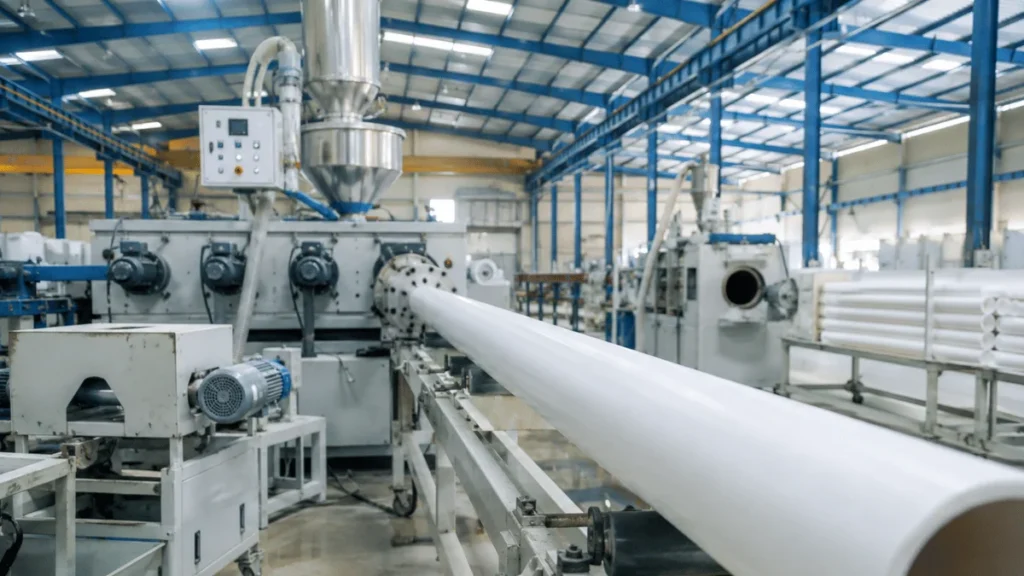
A PVC pipe manufacturing plant consists of several interconnected machines. Each performs a specific operation, and the required configuration depends on the products being manufactured.
| Machinery | Purpose |
| High-speed mixer | Prepares and blends PVC raw materials |
| PVC pipe extruder | Melts and processes the PVC compound |
| Die head and die mould | Forms the required pipe dimensions |
| Vacuum sizing tank | Helps establish pipe diameter and shape |
| Cooling tank | Cools the extruded pipe |
| Haul-off machine | Pulls the pipe through the production line |
| Cutting machine | Cuts pipes to specified lengths |
| Socketing machine | Forms sockets at pipe ends |
| Scrap grinder | Processes suitable production waste |
| Pulverizer | Reduces suitable material into finer particles |
Not every factory needs every machine at the beginning. For example, a manufacturer producing plain pipes may not initially require SWR socketing or slotting equipment.
The machinery list should therefore be prepared according to the intended product range and production workflow.
Also Read: How to Select a PVC Pipe Die Set for Consistent Dimensions and Surface Finish
3. Actual Machinery Prices Listed by DASS Engineering Private Limited
Buyers researching PVC pipe making machine prices often encounter quotations without detailed specifications. Published product prices can provide a useful starting point for comparing individual equipment.
DASS Engineering Private Limited currently displays the following prices on its product pages:
| Machinery | Listed price |
| Plastic Pipe Die Mould Set | ₹40,000 |
| PVC Pipe Plain Socketing Machine (Manual) | ₹98,000 |
| PVC Pipe Plain Socketing Machine (Semi-Automatic) | ₹1,75,000 |
| PVC Pipe Plain Socketing Machine (Automatic) | ₹1,90,000 |
| SWR Pipe Socketing Machine (Manual) | ₹1,50,000 |
| SWR Pipe Socketing Machine (Semi-Automatic) | ₹1,75,000 |
| SWR Pipe Socketing Machine (Automatic) | ₹1,95,000 |
| Plastic Pipe Slotting Machine | ₹1,65,000 |
| PVC, CPVC and HDPE Scrap Grinder (Rotator Type) | ₹2,60,000 |
| PVC Pulverizer Machine (Hammer Type) | ₹4,50,000 |
| PVC and CPVC Disc Pulverizer Machine | ₹5,50,000 |
Prices are published product-page prices checked on 21 November 2026. Confirm current pricing, applicable taxes, accessories, and delivery charges before ordering.
These examples demonstrate how the investment changes according to the machine’s purpose and configuration. They are prices of individual machines, not a quotation for a complete PVC pipe extrusion plant.
For example, the PVC Pipe Plain Socketing Machine from DASS Engineering supports pipes up to 330 mm and has a stated production capacity of 60–100 pipes per hour. Its automatic, semi-automatic, and manual variants have different prices and operating arrangements.
Explore the PVC Pipe Plain Socketing Machine for specifications and available configurations.
4. Main Extrusion Line vs Downstream Machinery: Understand the Difference
One common purchasing mistake is treating every machine used in PVC pipe production as part of the same equipment package.
The main extrusion line converts prepared PVC material into continuous pipes. It generally includes the extruder, die head, sizing system, cooling arrangement, haul-off, and cutting equipment.
Downstream machinery performs additional operations after pipe extrusion.
Examples include:
- Plain socketing machines: Form connection sockets on compatible PVC pipes.
- SWR socketing machines: Create the required socket configuration for SWR pipes.
- Slotting machines: Produce slots in applicable plastic pipe products.
- Scrap grinders: Reduce suitable manufacturing waste into smaller particles.
- Pulverizers: Process suitable plastic material into finer particles.
DASS Engineering manufactures several of these downstream machines and plastic pipe tooling. Its published product range should not be confused with a complete extrusion-line package.
This distinction is important when comparing quotations because two suppliers may offer completely different scopes of supply.
You May Like: When Should You Replace Plastic Grinder Blades? Signs Manufacturers Should Watch
5. Additional Expenses That Affect the Total Investment
The PVC pipe manufacturing plant cost involves more than the machinery purchase price. The overall project budget should also account for various supplementary costs that may arise.
Factory Infrastructure
The facility needs sufficient space for production equipment, raw material storage, finished pipe handling, and movement between manufacturing stages.
Consider factory rent or construction, flooring, machine foundations, storage arrangements, and material-handling facilities.
Electrical and Utility Requirements
Extrusion machinery, heaters, motors, cooling systems, and auxiliary equipment require suitable electrical infrastructure.
Before purchasing, obtain the connected-load details and electrical requirements for every proposed machine. Also evaluate water supply, cooling arrangements, and compressed-air requirements where applicable.
Raw Materials and Working Capital
Manufacturers must budget for PVC resin, stabilisers, processing additives, pigments, and other formulation components.
Working capital should also cover:
- Electricity and other utilities.
- Employee wages.
- Packaging and transportation.
- Routine maintenance.
- Replacement components.
- Inventory and customer credit periods.
Installation and Transportation
Depending on the supplier’s quotation, additional expenses may include transportation, unloading, installation, commissioning, and operator training.
Always check which services are included before confirming an order.
Also Read: Before Buying a PVC Scrap Grinder: How to Match Waste Type, Output Size, and Processing Needs
6. How to Calculate Your PVC Pipe Manufacturing Plant Cost
A practical way to estimate the PVC pipe manufacturing plant cost is to prepare a separate budget for each investment category.
Use this calculation:
Total initial investment =
- Main extrusion machinery
- Auxiliary equipment and tooling
- Downstream machinery
- Factory infrastructure
- Electrical and utility installation
- Transportation and commissioning
- Initial raw material inventory
- Working capital
For example, if a buyer receives separate quotations for an extruder, die set, vacuum tank, haul-off, cutter, and socketing machine, each amount should be entered into the appropriate budget category.
Additional expenses should be added separately rather than assumed to be included in the machinery quotation.
This approach provides a more realistic picture of the investment and makes supplier comparisons easier.
7. How to Select the Right PVC Pipe Manufacturing Machinery
Choosing equipment solely because it has the lowest purchase price can create problems later if its specifications do not match the factory’s requirements.
Before finalising a purchase, check:
- Pipe specifications: Identify the diameter range, wall thickness, and product standards.
- Production targets: Establish the expected output and operating schedule.
- Machine configuration: Compare motor capacity, control systems, and automation.
- Tooling compatibility: Verify die heads, die moulds, and sizing components.
- Material requirements: Confirm suitability for the intended PVC formulation.
- Maintenance: Understand servicing schedules and replacement-component availability.
- After-sales support: Clarify installation assistance, technical guidance, and warranty conditions.
A detailed technical comparison can help prevent purchasing equipment that is either insufficient for the production requirement or unnecessarily expensive.
Also Read: The Production Gaps Hidden Between PVC Machine Capacity and Actual Output
8. Why Consider DASS Engineering Private Limited?
DASS Engineering Private Limited has manufacturing experience dating back to 1975 and operates from Patna, Bihar. Its machinery range serves PVC, CPVC, HDPE, and PET processing applications.
The company manufactures plastic pipe tooling and downstream equipment, including plain and SWR socketing machines, slotting machines, scrap grinders, and pulverizers.
Its engineering capabilities include in-house design, CAD/CAM development, machining, fitting, and dimensional inspection. The company also uses certified EN8 and EN9 materials for relevant die components according to application requirements.
For buyers, the practical starting point is to share the intended pipe material, dimensions, production requirements, and machinery specifications before requesting a quotation.
Explore the DASS Engineering product range or contact the engineering team to discuss your machinery requirements.
Frequently Asked Questions
1. What is the PVC pipe making machine price in India?
The price varies according to machine type, production capacity, pipe dimensions, automation, and tooling. Individual downstream machinery prices are available on DASS Engineering’s product pages, while a complete extrusion-line quotation requires specific production details.
2. What is the cost of setting up a complete PVC pipe manufacturing plant?
The investment depends on the extrusion line, auxiliary machinery, tooling, infrastructure, utilities, raw materials, and working capital. There is no single reliable price without defining the proposed plant configuration.
3. Which machines are required to manufacture PVC pipes?
A typical production line requires a mixer, extruder, die head, die mould, vacuum sizing tank, cooling tank, haul-off machine, and cutting unit. Additional socketing and processing machines depend on the products manufactured.
4. Is an automatic PVC pipe making machine worth the investment?
Automatic machinery can reduce manual involvement and support repetitive production. However, its suitability depends on output requirements, labour availability, budget, and operating conditions.
5. What affects PVC pipe manufacturing machine cost?
Important factors include extrusion capacity, screw and motor specifications, pipe diameter, tooling, automation, machine construction, customization, and included accessories.
6. What information should I provide when requesting a machinery quotation?
Share the pipe material, diameter range, wall thickness, expected production output, operating hours, automation preference, and required machinery. These details help the supplier assess the appropriate configuration.
Conclusion
The PVC pipe making machine price in India should be evaluated as part of a complete manufacturing investment rather than as the cost of one individual machine.
Production capacity, extrusion configuration, tooling, downstream equipment, electrical infrastructure, installation, and working capital all influence the total budget.
Before purchasing, define your product range, compare technical specifications, and obtain a quotation that clearly identifies the machinery and services included.
DASS Engineering Private Limited provides plastic pipe tooling and downstream machinery for different manufacturing and material-processing requirements. Understanding your production needs before selecting equipment can help make the purchasing decision more practical and financially sound.