
AI in PVC Pipe Manufacturing: Quality Control and Efficiency
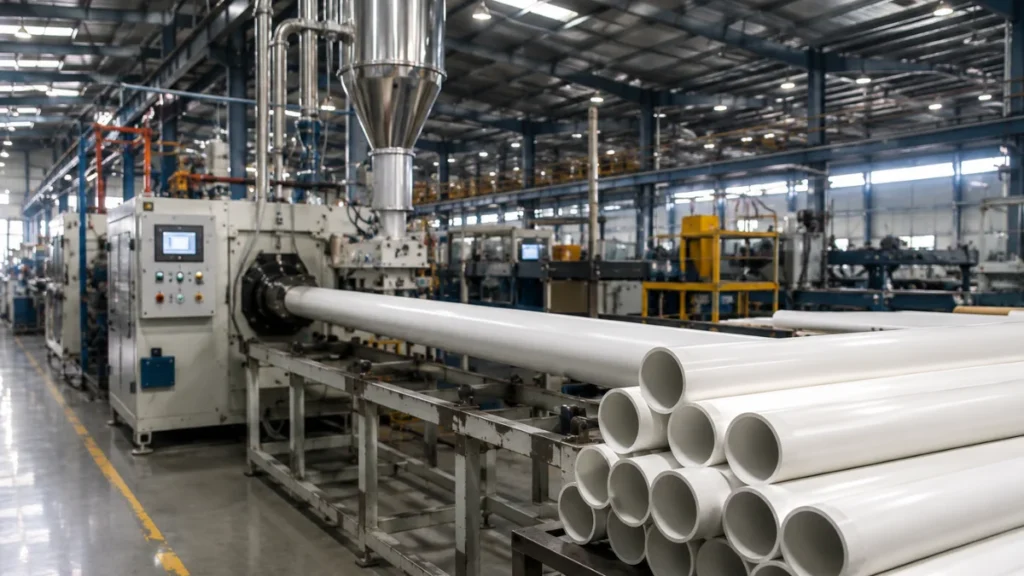
PVC pipe manufacturing involves several interconnected operations, including material preparation, extrusion, calibration, cooling, cutting, and quality inspection. A problem at one stage can affect the finished product, increase material waste, or interrupt production.
Artificial intelligence (AI) is creating new opportunities to analyse manufacturing data, monitor equipment, and identify production irregularities. The growing interest in AI in PVC pipe manufacturing reflects a shift towards smarter, data-driven factory operations.
From identifying visible defects to analysing machinery performance, AI-assisted technologies can help manufacturers make more informed decisions. However, their effectiveness depends on reliable data, compatible equipment, and appropriate technical implementation.
This article explores how AI can support PVC pipe manufacturers, its practical applications, and the considerations involved in adopting these technologies.
What Does AI Mean for PVC Pipe Manufacturing?
Artificial intelligence enables computer systems to examine information, recognise patterns, and generate predictions or recommendations.
In a PVC manufacturing facility, relevant information may include extrusion temperature, pressure, motor load, production speed, cooling conditions, pipe dimensions, and machine operating hours.
Conventional automation follows programmed instructions, whereas AI-assisted systems can analyse historical and current information to identify unusual patterns.
For example, if dimensional variations repeatedly occur alongside certain extrusion conditions, an analytical system may highlight that relationship for engineers to investigate.
AI in plastic pipe manufacturing is therefore not simply about replacing manual operations. It involves using production information to improve monitoring, troubleshooting, and operational decisions.
1. AI-Powered Quality Control in PVC Pipe Production
Maintaining consistent pipe dimensions and surface quality requires regular inspection. Traditional methods often involve manual measurements and periodic sampling, which may not identify every temporary production variation.
AI-powered quality control can support inspection through computer vision systems that analyse images of pipes moving along the production line.
Depending on the inspection equipment, these systems may identify:
- Surface scratches and visible imperfections.
- Colour variations between pipe sections.
- Irregular surface patterns.
- Certain visible extrusion defects.
- Changes in the appearance of finished products.
When connected with suitable measurement instruments, automated inspection can also help identify dimensional variations.
However, cameras cannot establish every structural or mechanical property of a pipe. Appropriate dimensional measurements and product testing remain necessary to verify product quality.
2. Predictive Maintenance in PVC Machinery
Unexpected equipment failures can interrupt production and increase maintenance expenses. Motors, bearings, gearboxes, heating systems, and other components require regular attention.
Predictive maintenance in PVC machinery involves analysing equipment information to identify possible signs of developing problems.
AI-assisted monitoring systems can examine:
- Motor current and operating load.
- Equipment temperature and vibration.
- Gearbox operating conditions.
- Machine operating hours.
- Previous maintenance records.
For example, unusual vibration readings may indicate a developing mechanical issue that requires inspection. Maintenance personnel can investigate the equipment and plan corrective work where necessary.
Predictive maintenance cannot guarantee that every breakdown will be forecast. Its effectiveness depends on sensor accuracy, historical information, and proper technical interpretation.
Read More: Is PVC Pipe Manufacturing Profitable?
3. AI in Extrusion Process Optimization
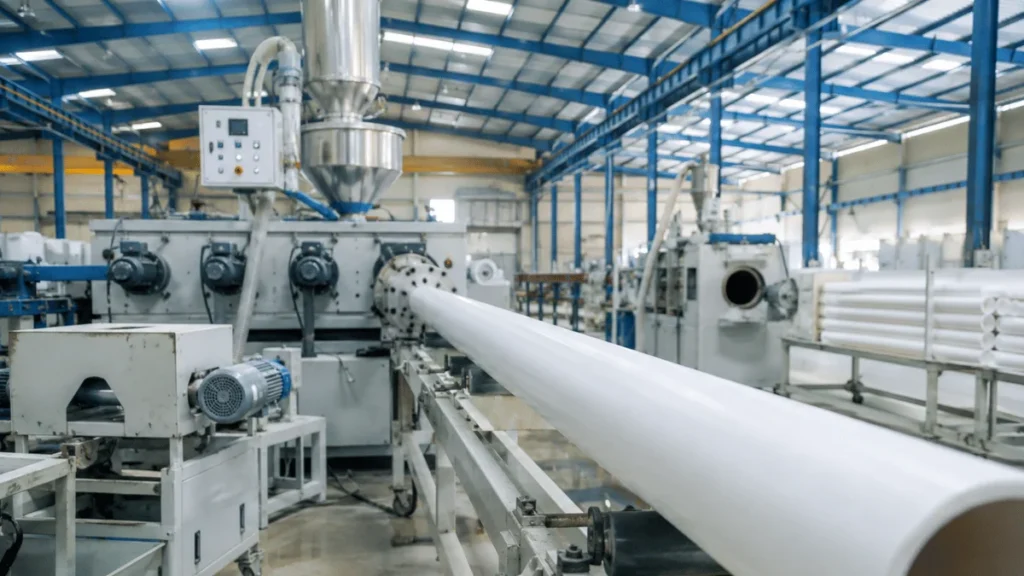
PVC extrusion requires coordination between material feeding, temperature settings, screw operation, pressure, production speed, calibration, and cooling.
AI in extrusion process optimization can help engineers examine these operating variables together rather than evaluating individual measurements in isolation.
By analysing production records, AI-assisted systems may identify patterns associated with:
- Fluctuations in extrusion output.
- Variations in pipe dimensions.
- Changes in motor loading.
- Repeated production interruptions.
- Increased material rejection.
For instance, engineers can compare extrusion temperature, production speed, and quality inspection records to investigate recurring defects.
Any recommended process adjustment must be evaluated against the PVC compound supplier’s guidance and equipment specifications. Incorrect processing conditions can affect material quality and create additional production problems.
4. How Can AI Help Reduce Material Waste?
Material waste can occur during machine start-up, product changeovers, quality rejection, and unstable production conditions.
AI-assisted manufacturing analysis can help factories understand where these losses occur by examining production and material records.
Useful information includes raw material consumption, finished pipe quantities, rejected products, changeover scrap, and recovered plastic material.
For manufacturers operating scrap grinders and pulverizers, production records can also help track how much waste is generated and how much material is recovered.
AI may identify recurring patterns associated with material losses, but it cannot automatically make contaminated or incompatible PVC scrap suitable for reuse. Proper segregation, inspection, and formulation compatibility remain essential.
Read More: Why PVC Pipe Factories Are Focusing More on Scrap Recovery and Recycling
5. Smart Manufacturing and PVC Pipe Production Automation
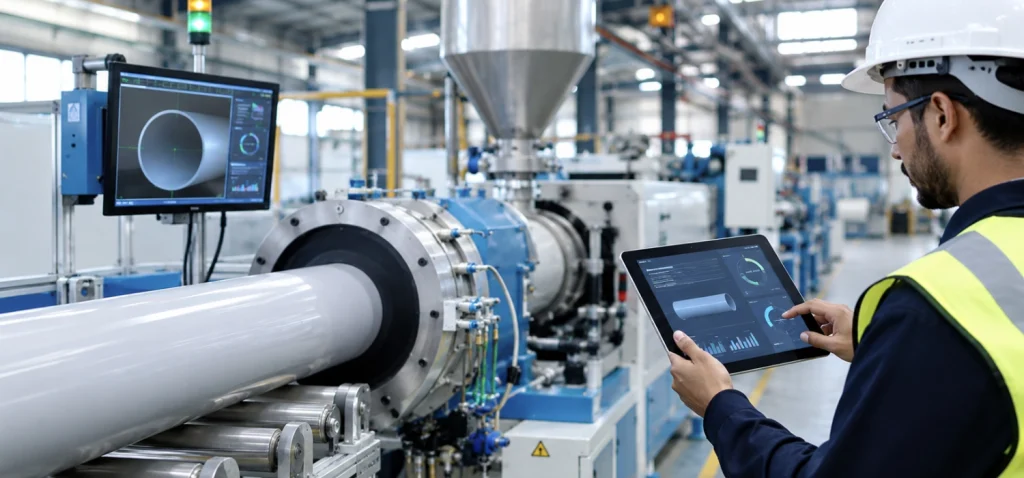
Smart manufacturing in PVC pipe production combines connected machinery, sensors, monitoring software, and automation.
A connected manufacturing line can collect operating information from the extruder, calibration equipment, cooling system, haul-off unit, and cutting machine.
AI can analyse this information and highlight unusual operating patterns for further investigation.
For example, production records might reveal repeated interruptions during particular product changeovers. Engineers can examine whether material preparation, tooling adjustments, or machine settings contribute to the problem.
PVC pipe production automation and AI are related but different concepts. Automation performs defined operations, while AI-assisted analysis helps interpret information and identify potential improvements. Both can complement each other in a properly designed factory.
6. AI for Energy Efficiency and Supply Chain Management
Electricity consumption in PVC manufacturing comes from extrusion motors, barrel heaters, cooling systems, and auxiliary equipment.
AI-assisted energy monitoring can compare electricity consumption with production output and operating conditions. This may help manufacturers investigate idle running, unusual motor loading, and differences in energy requirements between production runs.
AI can also support supply chain planning by analysing purchasing history, stock levels, material consumption, and production schedules.
Potential applications include:
- Estimating future raw material requirements.
- Supporting inventory management.
- Identifying frequently required spare parts.
- Reviewing material consumption patterns.
- Assisting procurement planning.
These predictions support business decisions but cannot guarantee future demand or supplier availability.
7. Challenges of Introducing AI into Existing PVC Factories
Adopting AI requires appropriate infrastructure and planning. Older machines may not provide the digital information needed by advanced monitoring systems.
Manufacturers should evaluate several considerations before implementation:
- Data availability: Reliable production measurements are necessary for meaningful analysis.
- Machine compatibility: Sensors and software must work with existing equipment.
- Implementation expenses: Hardware, integration, software, and training involve investment.
- Employee training: Operators must understand monitoring information and its limitations.
- Data security: Connected manufacturing systems require suitable access controls.
- Performance measurement: Factories should establish measurable objectives before investing.
A gradual introduction is often practical. Manufacturers can begin with one production line or a specific monitoring requirement before considering wider implementation.
8. What Should Manufacturers Consider Before Adopting AI?
Before investing in AI, PVC pipe manufacturers should identify the production problem they want to address.
For businesses evaluating machinery from a Top PVC Pipe Machinery Manufacturer in India, future monitoring and automation compatibility can also be considered during equipment selection.
Important questions include:
- Does the existing machinery provide usable operating data?
- Which sensors or measurement instruments are required?
- Can monitoring software integrate with existing control systems?
- What are the implementation and maintenance expenses?
- Will employees need additional technical training?
- How will actual improvements be measured?
Not every manufacturing unit needs a comprehensive AI system. The appropriate investment depends on production requirements, operational challenges, available infrastructure, and budget.
Read More: When Should You Replace Plastic Grinder Blades? Signs Manufacturers Should Watch
Frequently Asked Questions
1. How is AI used in PVC pipe manufacturing?
AI can analyse production data, assist with visible defect detection, monitor machinery conditions, support maintenance planning, and identify patterns in extrusion performance.
2. Can AI detect defects in PVC pipes?
Computer vision systems can identify certain visible imperfections. Suitable measurement instruments and product testing remain necessary to evaluate dimensional and mechanical properties.
3. What is predictive maintenance in PVC machinery?
It involves analysing equipment measurements and operating records to identify possible signs of developing mechanical problems and support maintenance planning.
4. Can AI improve PVC extrusion efficiency?
AI-assisted systems can analyse temperature, pressure, motor load, and production speed to help engineers investigate process variations. Actual improvements depend on appropriate technical decisions.
5. Is AI suitable for small PVC manufacturing factories?
Yes. Smaller factories can begin with selected applications such as equipment monitoring, production-record analysis, or automated visual inspection rather than investing in a complete AI infrastructure.
6. Does AI replace human operators in PVC manufacturing?
No. Operators and engineers remain essential for machine operation, troubleshooting, process adjustments, maintenance, and finished-product quality decisions.
Conclusion
Artificial intelligence is creating new opportunities for PVC pipe manufacturers seeking better production monitoring, improved inspection, and more informed maintenance planning.
From AI-powered quality control and predictive maintenance in PVC machinery to AI in extrusion process optimization, these technologies can help factories make better use of their manufacturing information.
Successful implementation requires reliable data, compatible equipment, trained employees, and clearly defined objectives. For DASS Engineering Private Limited and the wider PVC machinery industry, understanding these developments is important as manufacturing moves towards more connected and data-driven operations.
The real value of AI lies in addressing genuine production challenges rather than adopting technology simply because it is new.