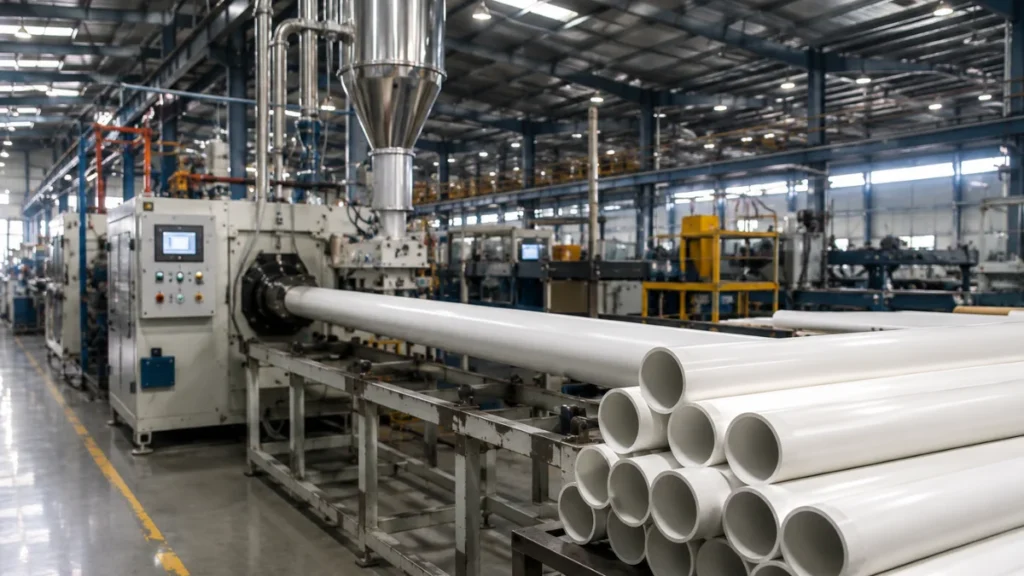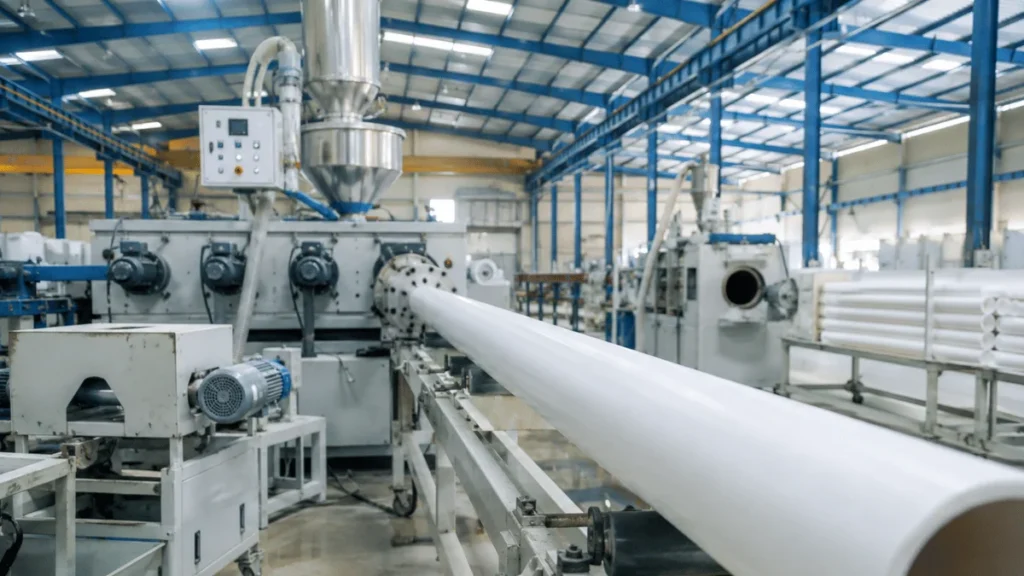

Producing PVC pipes with consistent dimensions and a smooth surface requires more than a capable extrusion machine. The die set, material formulation, temperature settings, calibration system, and cooling conditions all affect the finished pipe’s quality. If the tooling is unsuitable for the product or incompatible with the extrusion line, manufacturers may experience dimensional variation, surface irregularities, or difficulties maintaining consistent production.
Selecting the right PVC pipe die set starts with understanding the pipe you’re manufacturing. Diameter, wall thickness, material formulation, production requirements, and applicable quality standards should all influence the decision. A die set designed for one product cannot automatically be assumed suitable for every other pipe specification.
For manufacturers planning to purchase new tooling or upgrade an existing extrusion line, this guide explains the important selection criteria, the relationship between die design and pipe quality, common defects to investigate, and maintenance practices that support consistent production.
What Is a PVC Pipe Die Set?
A PVC pipe die set is the tooling assembly used to shape processed PVC material into a pipe during extrusion. It is installed at the outlet of the extrusion system, where the material flows through a specifically designed passage to form a continuous tubular profile.
The die assembly must work with the extruder and downstream equipment to produce the required pipe dimensions. After the material leaves the die, calibration and cooling equipment help establish and maintain its final geometry.
The die set therefore plays an important role in determining the shape and initial dimensions of the emerging pipe. However, the final product also depends on material behaviour, extrusion stability, calibration, cooling, and the condition of the complete production line.
Before selecting tooling, manufacturers should establish the pipe specifications they need to produce and identify the operating conditions under which the die will be used.
Read This: When Should You Replace Plastic Grinder Blades? Signs Manufacturers Should Watch
Why Does Die-Set Selection Matter in PVC Pipe Manufacturing?
A suitable die set helps manufacturers maintain the intended pipe geometry and achieve a surface finish appropriate for the application. Poorly matched or incorrectly adjusted tooling may contribute to uneven material distribution, dimensional variation, or visible surface defects.
The consequences can extend beyond appearance. Pipes that fall outside the required dimensional tolerances may create problems during fitting, joint formation, installation, or quality inspection.
Selecting suitable tooling also supports more predictable production planning. When the die set is compatible with the extrusion line and the intended PVC formulation, manufacturers have a better starting point for establishing stable process conditions.
However, a new die set does not automatically resolve every quality issue. Problems caused by inconsistent material preparation, unsuitable temperature settings, worn calibration components, or inadequate cooling require separate investigation.
Read More: Before Buying a PVC Scrap Grinder: How to Match Waste Type, Output Size, and Processing Needs
Seven Factors to Consider When Selecting a PVC Pipe Die Set
1. Required Pipe Diameter and Wall Thickness
The first consideration is the dimensional specification of the pipe. Manufacturers should identify the required outside diameter, wall thickness, dimensional tolerances, and applicable product standard before comparing die sets.
Different pipe sizes require tooling designed for the intended dimensions and extrusion conditions. A die set selected without reference to the complete pipe specification may produce a profile that requires excessive downstream adjustment or cannot consistently meet the required tolerances.
Before purchasing, document the product range the tooling must support. If multiple pipe sizes are manufactured on the same line, confirm which die sets, mandrels, and related components are required for each product.
Also Read: The Production Gaps Hidden Between PVC Machine Capacity and Actual Output
2. PVC Formulation and Processing Requirements
PVC formulations can differ according to the intended application and the characteristics required in the finished product. These differences may influence material flow, thermal behaviour, and the conditions needed for stable extrusion.
The die set should therefore be suitable for the intended formulation and processing window. Manufacturers should discuss material requirements with the tooling supplier and extrusion-equipment manufacturer rather than assuming that one configuration will perform identically with every compound.
Changes to the formulation may also affect surface appearance and dimensional stability. When a defect appears after a material change, investigate the formulation and processing conditions alongside the tooling.
3. Die Design and Material Distribution
The internal geometry of a PVC pipe extrusion die influences how material flows through the tooling and emerges as a tubular profile. The design must support an appropriate distribution of material around the circumference while accounting for the characteristics of the formulation and the production line.
Uneven material flow can contribute to circumferential differences in wall thickness. However, the same symptom may also result from die misalignment, unstable extrusion output, or downstream calibration problems.
When evaluating a die set, ask how its design relates to the intended pipe dimensions, material, and operating conditions. Request relevant technical drawings or specifications where available, and confirm that the tooling is compatible with the rest of the extrusion system.
You May Like: PVC Resin Price Trend in India 2026: What Pipe Manufacturers Should Know
4. Die Material and Surface Finish
The material used to manufacture a die set affects its suitability for the intended operating environment, including wear resistance, maintenance requirements, and the ability to maintain the specified tooling geometry.
Tooling materials should be evaluated against the manufacturer’s design requirements and the production conditions in which they will be used. Surface finishing is also important because the condition of material-contact surfaces can influence flow and the appearance of the emerging pipe.
A smooth-looking die is not, by itself, proof of good performance. Manufacturers should also consider dimensional accuracy, machining quality, material suitability, and the condition of the complete assembly.
Before purchasing, ask about the tooling material, applicable manufacturing specifications, inspection procedures, and recommended maintenance practices.
5. Compatibility With the Existing Extrusion Line
A die set must fit and operate correctly with the intended extrusion equipment. Mechanical compatibility, connection dimensions, mounting arrangements, and alignment requirements should be confirmed before an order is finalised.
Compatibility also extends beyond physical fit. The tooling must be appropriate for the extruder’s operating conditions and the downstream calibration and cooling equipment.
When evaluating a replacement die set, provide the supplier with the relevant machine details and current product specifications. Do not assume that tooling intended for a similar-looking machine will necessarily be suitable for your line.
Read More: Why PVC Pipe Factories Are Focusing More on Scrap Recovery and Recycling
6. Dimensional Accuracy and Quality Requirements
The tooling should be selected with reference to the required finished-pipe tolerances and inspection methods. Manufacturers need to know which dimensions must be controlled and how product conformity will be assessed.
Depending on the application, checks may include outside diameter, wall thickness, ovality, and visual surface condition. The applicable requirements should be established from the relevant product specification or standard rather than assumed to be identical across all PVC pipes.
A useful purchasing discussion should cover the expected dimensional requirements, available inspection documentation, and the process for verifying the finished pipe after installation.
7. Maintenance, Adjustability, and Technical Support
The purchase decision should include an assessment of how the die set will be inspected, cleaned, maintained, and serviced over time. Tooling that is difficult to maintain or lacks clear technical documentation can complicate routine production work.
Before ordering, clarify the availability of replacement components, maintenance instructions, and technical assistance. Also establish which adjustments are permitted and which tasks require a trained technician.
These details help manufacturers assess the practical requirements of operating the tooling rather than focusing exclusively on its initial price.
Read More: How Socketing, Slotting, and Scrap Processing Complete a PVC Pipe Production Line
How Does a PVC Pipe Die Set Affect Dimensions and Surface Finish?
The die set influences how the molten PVC compound is shaped as it leaves the extruder. Its geometry, alignment, and surface condition can affect material distribution and the initial shape of the emerging pipe.
For example, uneven material flow through the die may contribute to wall-thickness variation. If the tooling is misaligned, the material may not be distributed as intended around the circumference. A damaged or contaminated material-contact surface may also contribute to visible irregularities.
Nevertheless, not every dimensional or surface defect originates in the die. Calibration equipment helps establish the pipe’s final dimensions, while cooling conditions influence how the material retains its shape. Unstable extrusion output and inconsistent material properties can also affect the result.
Manufacturers should therefore assess the die set as part of the complete production system. Replacing tooling without identifying the actual source of a defect can add cost without resolving the underlying problem.
Common PVC Pipe Defects and What to Investigate
Visible defects can provide useful clues, but each symptom may have more than one possible cause. The correct response depends on inspection findings and the operating conditions under which the defect occurs.
Read More: How to Start a PVC Manufacturing Company in India
Uneven Wall Thickness
Differences in wall thickness around the pipe may be associated with die alignment, uneven material distribution, unstable output, or calibration issues. Manufacturers should compare measurements at multiple points and inspect the relevant equipment before making adjustments.
Rough or Irregular Surface Finish
A rough surface may result from unsuitable processing conditions, material contamination, unstable flow, or problems with the die’s material-contact surfaces. Check the formulation, operating conditions, and tooling condition before deciding on corrective action.
Dimensional Variation
If outside diameter or wall thickness changes during production, investigate extrusion stability, calibration, cooling, and measurement consistency. A die-related problem is one possibility, but it should not be assumed without supporting evidence.
Ovality or Shape Distortion
A pipe that does not retain its intended circular shape may require investigation of calibration, cooling uniformity, material behaviour, and downstream handling. Die alignment may also need checking if evidence suggests uneven material distribution at the outlet.
A structured investigation should record the defect, pipe dimensions, material batch, operating settings, and recent maintenance or tooling changes. This makes it easier to distinguish a tooling issue from a process-related problem.
Read More: Is PVC Pipe Manufacturing Profitable?
Questions to Ask Before Purchasing a PVC Pipe Die Set
Before placing an order, manufacturers should provide enough information for the supplier to assess the application. A clear specification reduces uncertainty and helps both parties establish whether the proposed tooling matches the production requirement.
Use this checklist during the purchasing discussion:
- What pipe diameters, wall thicknesses, and tolerances must the tooling support?
- Which PVC formulation and operating conditions will be used?
- Is the die set compatible with the existing extruder and downstream equipment?
- What tooling material and surface-finish specifications are provided?
- What inspection documents or dimensional checks are available?
- What cleaning, maintenance, and adjustment procedures are recommended?
- Are technical support and replacement components available?
- How will the tooling’s suitability be evaluated during commissioning?
When evaluating a Top PVC Pipe Machinery Manufacturer in India, buyers should assess documented specifications, tooling compatibility, manufacturing quality, and technical support rather than relying solely on broad performance claims. The right choice depends on the requirements of the individual production line and the quality standards the finished pipes must meet.
How to Maintain a PVC Pipe Die Set
Proper maintenance helps preserve tooling condition and makes it easier to identify wear or damage before it affects production. The maintenance procedure should always follow the tooling supplier’s and equipment manufacturer’s instructions.
After the line has been safely shut down and the tooling has reached a suitable condition for handling, trained personnel can carry out the prescribed inspection and cleaning procedures. Abrasive cleaning methods or unauthorised alterations should be avoided if they could damage the tooling’s precision surfaces.
A practical maintenance routine should include:
- Inspecting material-contact surfaces for wear, damage, or contamination.
- Checking mounting and alignment components as specified.
- Cleaning the tooling using approved methods.
- Recording inspection findings and maintenance activities.
- Storing removed tooling in a clean, protected environment.
- Rechecking alignment and installation requirements before restarting production.
Maintenance records can help identify recurring defects and establish when additional inspection is needed. If surface damage, unusual wear, or dimensional problems are found, consult a qualified technician before returning the tooling to service.
Frequently Asked Questions
1. What is the main function of a PVC pipe die set?
A PVC pipe die set shapes the processed PVC compound into a continuous tubular profile as it exits the extruder. Its design must match the intended pipe specifications and work with the calibration and cooling equipment downstream.
2. Can the wrong die set cause uneven pipe wall thickness?
Yes, unsuitable tooling or incorrect alignment can contribute to uneven wall thickness. However, unstable extrusion output, material variation, and calibration problems can produce similar symptoms, so the complete process should be checked.
3. Does a better die set guarantee a smooth PVC pipe surface?
No. Tooling condition and design can influence surface quality, but material formulation, temperature settings, extrusion stability, and other process conditions also matter. A smooth finish requires the production system to operate within suitable conditions.
4. What should manufacturers check before buying a PVC pipe extrusion die?
Confirm the pipe dimensions, wall-thickness requirements, PVC formulation, die material, tooling specifications, compatibility with the extrusion line, maintenance requirements, and applicable quality standards.
5. How often should a PVC pipe die set be inspected?
Inspection frequency depends on the tooling design, production conditions, operating hours, and manufacturer recommendations. Follow the specified maintenance schedule and arrange additional inspections when defects, wear, or unusual operating behaviour appear.
6. Can one PVC pipe die set be used for different pipe sizes?
That depends on the tooling design and the manufacturer’s specifications. Different pipe dimensions may require different die components or complete die sets. Confirm the permitted product range with the tooling supplier before changing sizes.
Conclusion
Selecting a PVC pipe die set requires a clear understanding of the finished pipe dimensions, material formulation, extrusion conditions, tooling specifications, and downstream equipment. These factors influence whether the tooling is appropriate for the intended application and whether the production line can maintain the required quality.
Before purchasing, confirm dimensional requirements, evaluate material and surface-finish specifications, check compatibility with the existing line, and establish the maintenance and inspection requirements. When defects occur, investigate the complete extrusion process instead of assuming that the die set is always responsible.
A carefully selected and properly maintained die set provides a sound starting point for producing PVC pipes with consistent dimensions and an acceptable surface finish. Actual results depend on the performance of the complete manufacturing process and verification against the relevant product requirements.